

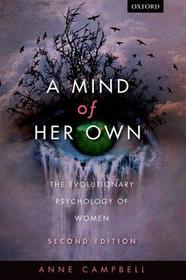
A Mind Of Her Own
The evolutionary psychology of women
-
10% KEDVEZMÉNY?
- A kedvezmény csak az 'Értesítés a kedvenc témákról' hírlevelünk címzettjeinek rendeléseire érvényes.
- Kiadói listaár GBP 64.00
-
30 576 Ft (29 120 Ft + 5% áfa)
Az ár azért becsült, mert a rendelés pillanatában nem lehet pontosan tudni, hogy a beérkezéskor milyen lesz a forint árfolyama az adott termék eredeti devizájához képest. Ha a forint romlana, kissé többet, ha javulna, kissé kevesebbet kell majd fizetnie.
- Kedvezmény(ek) 10% (cc. 3 058 Ft off)
- Kedvezményes ár 27 518 Ft (26 208 Ft + 5% áfa)
Iratkozzon fel most és részesüljön kedvezőbb árainkból!
Feliratkozom
30 576 Ft

Beszerezhetőség
Megrendelésre a kiadó utánnyomja a könyvet. Rendelhető, de a szokásosnál kicsit lassabban érkezik meg.
Why don't you give exact delivery time?
A beszerzés időigényét az eddigi tapasztalatokra alapozva adjuk meg. Azért becsült, mert a terméket külföldről hozzuk be, így a kiadó kiszolgálásának pillanatnyi gyorsaságától is függ. A megadottnál gyorsabb és lassabb szállítás is elképzelhető, de mindent megteszünk, hogy Ön a lehető leghamarabb jusson hozzá a termékhez.
A termék adatai:
- Kiadás sorszáma 2
- Kiadó OUP Oxford
- Megjelenés dátuma 2013. május 16.
- ISBN 9780199609543
- Kötéstípus Puhakötés
- Terjedelem440 oldal
- Méret 238x167x23 mm
- Súly 646 g
- Nyelv angol 0
Kategóriák
Rövid leírás:
In the new edition of a successful book, Anne Campbell redresses the balance of evolutionary theory in favour of women. She examines how selection pressures have shaped the female mind over thousands of generations: Their emotions, friendship, competition, aggression and mate choice.
TöbbHosszú leírás:
When Darwin proposed that females shape evolution by being choosy in their choice of male suitors, his Victorian contemporaries were shocked that he accorded so much importance to women. But this early view of the female role was far from revolutionary: They were simply allowed to be passive 'quality controllers' of male genes.
Recent years have shown that the inert 'coy female' is a myth. For a male, a high sex drive and a taste for variety may improve his fitness. But for a female, successful reproduction goes far beyond copulation. She bears the brunt of parental investment with each child represents years of commitment from pregnancy and breast-feeding to provisioning and guarding. For her genetic lineage to survive, she must do this better than her rivals. Each of us comes from a line of winning mothers. Women are, after all, the first and default sex. It is women who bear children. A child born with a single X chromosome can survive, but not one with a single Y. In a population crash, a female-biased population will survive far better than a male-heavy one.
In this book, Anne Campbell redresses the balance of evolutionary theory in favour of women. She examines how selection pressures have shaped the female mind over thousands of generations: Their emotions, friendship, competition, aggression and mate choice. She brings together data from neuroscience, endocrinology, anthropology, primatology as well as psychology to address fundamental questions about sex differences.... Why are women less aggressive than men? Were women designed for monogamy or promiscuity? What do women compete for? Why is conflict between males and females inevitable? What makes each woman unique? Have contraception and IVF subverted the process of natural selection?
Review from previous edition In her readable and thought-provoking account, Campbell argues that there are profound differences between women, and that this is both a cause and a consequence of directional selection on female psychology... Campbell provides an excellent taxonomy of nine classes of feminism This book will stimulate an important debate and ensure that evolution cannot be ignored.
Tartalomjegyzék:
The essential woman: Biophobia and the study of sex differences
Mothers matter most: Women and parental investment
High stakes and low risks: Women and aggression
Who does she think she is? Women and status
Like a sister: Women and friendship
But she that filches from me my good name: Women and mate competition
A coincidence of interests: Women and monogamy
Individual differences: The unique woman
The flexible phenotype: Women and culture

