

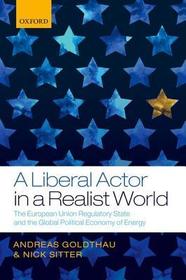
A Liberal Actor in a Realist World
The European Union Regulatory State and the Global Political Economy of Energy
-
10% KEDVEZMÉNY?
- A kedvezmény csak az 'Értesítés a kedvenc témákról' hírlevelünk címzettjeinek rendeléseire érvényes.
- Kiadói listaár GBP 105.00
-
47 407 Ft (45 150 Ft + 5% áfa)
Az ár azért becsült, mert a rendelés pillanatában nem lehet pontosan tudni, hogy a beérkezéskor milyen lesz a forint árfolyama az adott termék eredeti devizájához képest. Ha a forint romlana, kissé többet, ha javulna, kissé kevesebbet kell majd fizetnie.
- Kedvezmény(ek) 10% (cc. 4 741 Ft off)
- Kedvezményes ár 42 667 Ft (40 635 Ft + 5% áfa)
Iratkozzon fel most és részesüljön kedvezőbb árainkból!
Feliratkozom
47 407 Ft

Beszerezhetőség
Megrendelésre a kiadó utánnyomja a könyvet. Rendelhető, de a szokásosnál kicsit lassabban érkezik meg.
Why don't you give exact delivery time?
A beszerzés időigényét az eddigi tapasztalatokra alapozva adjuk meg. Azért becsült, mert a terméket külföldről hozzuk be, így a kiadó kiszolgálásának pillanatnyi gyorsaságától is függ. A megadottnál gyorsabb és lassabb szállítás is elképzelhető, de mindent megteszünk, hogy Ön a lehető leghamarabb jusson hozzá a termékhez.
A termék adatai:
- Kiadó OUP Oxford
- Megjelenés dátuma 2015. augusztus 13.
- ISBN 9780198719595
- Kötéstípus Keménykötés
- Terjedelem180 oldal
- Méret 241x167x16 mm
- Súly 442 g
- Nyelv angol 0
Kategóriák
Rövid leírás:
This book assesses the changing nature of the global political economy of energy and the European Union's response.
TöbbHosszú leírás:
Since 1992, the European Union has put liberalisation at the core of its energy policy agenda. This aspiration was very much in line with an international political economy driven by the neo-liberal (Washington) consensus. The central challenge for the EU is that the energy world has changed, while the EU has not. The rise of Asian energy consumers (China and India), more assertive energy producers (Russia), and the threat of climate change have securitized the IPE of energy, and turned it more 'realist'. The main research question is therefore: 'What does a liberal actor do in a realist world?' The overall answer as far as the EU is concerned is that it approaches energy challenges as a problem of market failure: imperfect competition on the supply side; inadequate supply of public goods on the demand side and in terms of infrastructure; and large externalities that arise both from non-energy events and from large-scale consumption of fossil fuels.
A Liberal Actor in a Realist World assesses the changing nature of the global political economy of energy and the European Union's response, and the external dimension of the regulatory state. The book concludes that the EU's soft power has a hard edge, which is derived primarily from its regulatory power. This works best when it targets companies rather than governments, and it is more effective in the 'Near Abroad' than at the global level. This makes the EU emerge an actor in its own right in the global political economy of energy - a 'Regulatory Power Europe'.
the study contributes widely to a literature which so far has not been particularly abundant ... also offers rich empirical evidence about what IPE actually entails in the EU and what the specific challenges are and which tools are involved. Finally, having established that the EU is a liberal regulatory state, the book asks several questions about EU actorness in the IPE of energy such as, for example, how the heterogeneity of preferences among Member states might impact on EU actorness externally. The monograph, therefore, not only contributes to the existing theoretical and empirical debate but also nourishes this debate with additional points for future research.
Tartalomjegyzék:
Introduction: Chapter 1: Introduction: The EU and the Changing International Political Economy of Energy
The Changing International Political Economy of Energy
The EU Regulatory State and Energy Security
Oil Markets. Dealing with Global Market Failures
Gas Markets: Dealing with Market Failures and Asymmetric Power in the Near Abroad
The Carbon Challenge. Dealing with the Externalities of Energy Markets
The Long Reach of the Regulatory State: 'Regulatory Power Europe'
Conclusion: A Liberal Actor in a Realist World

