

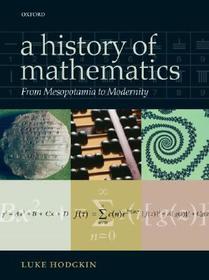
A History of Mathematics
From Mesopotamia to Modernity
-
10% KEDVEZMÉNY?
- A kedvezmény csak az 'Értesítés a kedvenc témákról' hírlevelünk címzettjeinek rendeléseire érvényes.
- Kiadói listaár GBP 125.00
-
59 718 Ft (56 875 Ft + 5% áfa)
Az ár azért becsült, mert a rendelés pillanatában nem lehet pontosan tudni, hogy a beérkezéskor milyen lesz a forint árfolyama az adott termék eredeti devizájához képest. Ha a forint romlana, kissé többet, ha javulna, kissé kevesebbet kell majd fizetnie.
- Kedvezmény(ek) 10% (cc. 5 972 Ft off)
- Kedvezményes ár 53 747 Ft (51 188 Ft + 5% áfa)
Iratkozzon fel most és részesüljön kedvezőbb árainkból!
Feliratkozom
59 718 Ft

Beszerezhetőség
Megrendelésre a kiadó utánnyomja a könyvet. Rendelhető, de a szokásosnál kicsit lassabban érkezik meg.
Why don't you give exact delivery time?
A beszerzés időigényét az eddigi tapasztalatokra alapozva adjuk meg. Azért becsült, mert a terméket külföldről hozzuk be, így a kiadó kiszolgálásának pillanatnyi gyorsaságától is függ. A megadottnál gyorsabb és lassabb szállítás is elképzelhető, de mindent megteszünk, hogy Ön a lehető leghamarabb jusson hozzá a termékhez.
A termék adatai:
- Kiadó OUP Oxford
- Megjelenés dátuma 2005. június 2.
- Kötetek száma laminated boards
- ISBN 9780198529378
- Kötéstípus Keménykötés
- Terjedelem296 oldal
- Méret 253x194x19 mm
- Súly 777 g
- Nyelv angol
- Illusztrációk numerous figures & halftones 0
Kategóriák
Rövid leírás:
A History of Mathematics: From Mesopotamia to Modernity covers the evolution of mathematics through time and across the major Eastern and Western civilizations. It begins in Babylon, then describes the trials and tribulations of the Greek mathematicians. The important, and often neglected, influence of both Chinese and Islamic mathematics is covered in detail, placing the description of early Western mathematics in a global context. The book concludes with modern mathematics, covering recent developments such as the advent of the computer,
chaos theory, topology, mathematical physics, and the solution of Fermat's Last Theorem. Containing more than 100 illustrations and figures, an extensive bibliography, and numerous exercises and solutions, this is an ideal teaching text.
Hosszú leírás:
A History of Mathematics: From Mesopotamia to Modernity covers the evolution of mathematics through time and across the major Eastern and Western civilizations. It begins in Babylon, then describes the trials and tribulations of the Greek mathematicians. The important, and often neglected, influence of both Chinese and Islamic mathematics is covered in detail, placing the description of early Western mathematics in a global context. The book concludes with modern mathematics, covering recent developments such as the advent of the computer, chaos theory, topology, mathematical physics, and the solution of Fermat's Last Theorem.
Containing more than 100 illustrations and figures, this text, aimed at advanced undergraduates and postgraduates, addresses the methods and challenges associated with studying the history of mathematics. The reader is introduced to the leading figures in the history of mathematics (including Archimedes, Ptolemy, Qin Jiushao, al-Kashi, al-Khwarizmi, Galileo, Newton, Leibniz, Helmholtz, Hilbert, Alan Turing, and Andrew Wiles) and their fields. An extensive bibliography with cross-references to key texts will provide invaluable resource to students and exercises (with solutions) will stretch the more advanced reader.
The book contains more than 100 illustrations, pictures and figures, and many exercises (with solutions). An extensive bibliography with cross-references will be very helpful for students and readers. The book will be interesting for undergraduate and postgraduate students of mathematics and other readers interested in the history and philosophy of mathematics.
Tartalomjegyzék:
Introduction
Babylonian mathematics
Greeks and 'Origins'
Greeks, practical and theoretical
Chinese mathematics
Islam, neglect and discovery
Understanding the 'Scientific Revolution'
The Calculus
Geometries and Space
Modernity and its Anxieties
A Chaotic End?
Bibliography
Index

