

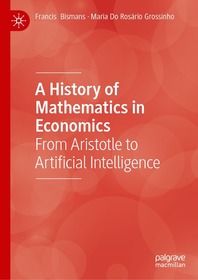
A History of Mathematics in Economics
From Aristotle to Artificial Intelligence
-
12% KEDVEZMÉNY?
- Kiadói listaár EUR 128.39
-
50 149 Ft (47 761 Ft + 5% áfa)
Az ár azért becsült, mert a rendelés pillanatában nem lehet pontosan tudni, hogy a beérkezéskor milyen lesz a forint árfolyama az adott termék eredeti devizájához képest. Ha a forint romlana, kissé többet, ha javulna, kissé kevesebbet kell majd fizetnie.
- Kedvezmény(ek) 12% (cc. 1 Ft off)
- Kedvezményes ár 44 131 Ft (42 030 Ft + 5% áfa)
44 131 Ft

Beszerezhetőség
Még nem jelent meg, de rendelhető. A megjelenéstől számított néhány héten belül megérkezik.
Why don't you give exact delivery time?
A beszerzés időigényét az eddigi tapasztalatokra alapozva adjuk meg. Azért becsült, mert a terméket külföldről hozzuk be, így a kiadó kiszolgálásának pillanatnyi gyorsaságától is függ. A megadottnál gyorsabb és lassabb szállítás is elképzelhető, de mindent megteszünk, hogy Ön a lehető leghamarabb jusson hozzá a termékhez.
A termék adatai:
- Kiadó Springer Nature Switzerland
- Megjelenés dátuma 2026. augusztus 3.
- ISBN 9783032173508
- Kötéstípus Keménykötés
- Terjedelem392 oldal
- Méret 210x148 mm
- Nyelv angol
- Illusztrációk XVI, 392 p. 33 illus., 3 illus. in color. 700
Kategóriák
Hosszú leírás:
"
This book explores the importance of mathematics (analysis, algebra, topology, probability, and inferential statistics) within the history and development of economics. It offers a long-term perspective on the links between mathematics and economics, taking into account the influence of historical events, to create a genealogy of quantitative economics. Starting with Aristotle and the early economic pioneers, such as Petty, Isnard, Cournot, Ricardo, Marx, and Walras, the development of economics over many centuries is charted, including marginalism, general equilibrium, neoclassical synthesis, linear economics, game theory, econometrics, financial theory, and artificial intelligence.
This book provides insight into an overlooked part of economics? history to create a new framework for economic analysis. It will be relevant to students and researchers interested in the history of economic thought from a quantitative perspective, filling a gap in the existing literature.
Tartalomjegyzék:
1. Introduction.- 2. The precursors (From Aristotle to Que?telet).- 3. Classicism and mathematics.- 4. Marginalism and general equilibrium.- 5. The first neoclassical synthesis.- 6. The years of formalized High Theory (1914-1940).- 7. Linear economics and mathematics (1911-1940).- 8. The new synthesis of the Great Thirties.- 9. New mathematics and general equilibrium.- 10. Game theory: The mathematics of economics.- 11. Exchanges, market forms and game theory.- 12. Econometrics: The Long March towards autonomy.- 13. Financial theory and mathematics.- 14. Big data and artificial intelligence in economics.
Több
