

-
10% KEDVEZMÉNY?
- Kiadói listaár GBP 44.99
-
20 312 Ft (19 345 Ft + 5% áfa)
Az ár azért becsült, mert a rendelés pillanatában nem lehet pontosan tudni, hogy a beérkezéskor milyen lesz a forint árfolyama az adott termék eredeti devizájához képest. Ha a forint romlana, kissé többet, ha javulna, kissé kevesebbet kell majd fizetnie.
- Kedvezmény(ek) 10% (cc. 2 031 Ft off)
- Kedvezményes ár 18 281 Ft (17 411 Ft + 5% áfa)
18 281 Ft

Beszerezhetőség
Becsült beszerzési idő: A Prosperónál jelenleg nincsen raktáron, de a kiadónál igen. Beszerzés kb. 3-5 hét..
A Prosperónál jelenleg nincsen raktáron.
Why don't you give exact delivery time?
A beszerzés időigényét az eddigi tapasztalatokra alapozva adjuk meg. Azért becsült, mert a terméket külföldről hozzuk be, így a kiadó kiszolgálásának pillanatnyi gyorsaságától is függ. A megadottnál gyorsabb és lassabb szállítás is elképzelhető, de mindent megteszünk, hogy Ön a lehető leghamarabb jusson hozzá a termékhez.
A termék adatai:
- Kiadás sorszáma 1
- Kiadó Stata Press
- Megjelenés dátuma 2026. május 24.
- ISBN 9781597184151
- Kötéstípus Puhakötés
- Terjedelem196 oldal
- Súly 400 g
- Nyelv angol 0
Kategóriák
Rövid leírás:
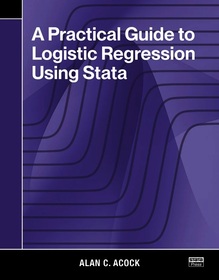
Alan Acock's book, A Practical Guide to Logistic Regression Using Stata, is for students and researchers who are new to logistic regression and who want to focus on applications, rather than theory. Readers will learn when to use logistic regression in their research and how to fit these models in Stata.
TöbbHosszú leírás:
Alan Acock's book, A Practical Guide to Logistic Regression Using Stata, is written for students and researchers who are new to logistic regression and who want to focus on applications rather than theory. This guide teaches when and why logistic regression is appropriate, how to easily fit these models by using Stata, and how to interpret and present the results.
The book begins with a review of OLS regression and an introduction to the concepts of logistic regression. It compares and contrasts these two methods and explains why logistic regression is usually the better approach to modeling binary outcome data. Along the way, readers will learn about parameter estimation for logistic regression models.
The author then turns his attention to interpreting the models and assessing model fit. The book demonstrates how to transform the coefficients into more interpretable odds ratios and how to estimate relative risks when appropriate. Acock next explains tools such as the pseudo-R², likelihood-ratio tests, Akaike's information criterion (AIC), and Schwarz's Bayesian information criterion (BIC) and shows how to use these tools to assess the fit of the model to the data.
Subsequent chapters focus on assessing a model's predictive utility using sensitivity, specificity, and receiver operating characteristic (ROC) curves. These concepts are explained clearly and demonstrated with practical examples.
The book concludes with a detailed discussion of how to build models with different kinds of predictor variables, how to use Stata's margins command to transform the model coefficients to predicted probabilities, and how to use marginsplot to create easily interpretable visualizations of the results. The author includes many examples using continuous and categorical predictors, illustrates various interactions between different predictor variables, and explains complications that may arise, such as multicollinearity.
A Practical Guide to Logistic Regression Using Stata provides a comprehensive, applications-oriented introduction to modeling binary outcomes using logistic regression. Readers at all levels will learn the skills to confidently fit, assess, interpret, and visualize these models using their own data.
TöbbTartalomjegyzék:
What we can do with logistic regression. Getting ready. Conventional ordinary least-squares regression versus logistic regression. Interpreting an odds ratio. What is wrong with ordinary least-squares regression for a binary outcome?. Fitting and interpreting logistic regression models. How well does the model fit the data?. Sensitivity and specificity. Receiver operating characteristic curves and cutpoints for screening tests. Predictions using the margins command. Graphic presentation using the marginsplot command. Curve fitting with quadratic models. Interaction. Running nestreg and postestimation commands. Special topics. A Appendix. References.
Több
