

-
10% KEDVEZMÉNY?
- Kiadói listaár GBP 155.00
-
69 982 Ft (66 650 Ft + 5% áfa)
Az ár azért becsült, mert a rendelés pillanatában nem lehet pontosan tudni, hogy a beérkezéskor milyen lesz a forint árfolyama az adott termék eredeti devizájához képest. Ha a forint romlana, kissé többet, ha javulna, kissé kevesebbet kell majd fizetnie.
- Kedvezmény(ek) 10% (cc. 6 998 Ft off)
- Kedvezményes ár 62 984 Ft (59 985 Ft + 5% áfa)
62 984 Ft

Beszerezhetőség
Még nem jelent meg, de rendelhető. A megjelenéstől számított néhány héten belül megérkezik.
Why don't you give exact delivery time?
A beszerzés időigényét az eddigi tapasztalatokra alapozva adjuk meg. Azért becsült, mert a terméket külföldről hozzuk be, így a kiadó kiszolgálásának pillanatnyi gyorsaságától is függ. A megadottnál gyorsabb és lassabb szállítás is elképzelhető, de mindent megteszünk, hogy Ön a lehető leghamarabb jusson hozzá a termékhez.
A termék adatai:
- Kiadás sorszáma 1
- Kiadó Routledge
- Megjelenés dátuma 2026. szeptember 22.
- ISBN 9781041349877
- Kötéstípus Keménykötés
- Terjedelem200 oldal
- Méret 216x138 mm
- Nyelv angol
- Illusztrációk 4 Illustrations, black & white; 4 Halftones, black & white; 7 Tables, black & white 0
Kategóriák
Rövid leírás:
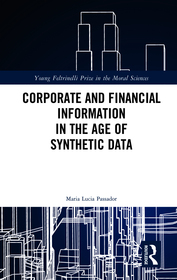
This book develops a general theory of synthetic data as an emerging object of corporate and financial law. As artificially generated datasets increasingly inform credit modelling, stress testing, ESG disclosure, algorithmic governance, and supervisory experimentation, are transforming the informational foundations of market life.
Több
Hosszú leírás:
This book develops a general theory of synthetic data as an emerging object of corporate and financial law. As artificially generated datasets increasingly inform credit modelling, stress testing, ESG disclosure, algorithmic governance, and supervisory experimentation, they are transforming the informational foundations of market life. In modern markets, knowledge is no longer simply observed; it is increasingly constructed.
t argues that, once informational premises are engineered rather than discovered, law can no longer be limited to regulating the use of data. It must also govern the conditions under which data are generated and rendered authoritative. Drawing together corporate governance, financial regulation, prudential supervision, data protection, and AI law, it develops a unifying framework—Bounded Simulation Governance—through which synthetic informational environments become legally intelligible.
At the core of the argument is the concept of simulation risk: a distinct form of systemic vulnerability arising when institutions rely on shared generative environments, with the result that hidden coordination, informational monoculture, and correlated fragility take shape across formally independent actors. Synthetic data thus emerge not merely as technical artefacts, but as legal infrastructures of judgment, discipline, and oversight.
Combining doctrinal analysis, institutional practice, and normative reconstruction, this book offers an original account of how law must adapt when artificial informational worlds become integral to corporate governance and financial regulation.
Több
Tartalomjegyzék:
Introduction PART I THE SYNTHETIC TURN: CONSTRUCTING INFORMATION AS A LEGAL OBJECT 1. Defining Synthetic Data: Ontology, Legal Status, and Boundary Conditions 2. Synthetic Data in Corporate and Financial Contexts: Institutional Diffusion and Governance Practice PART II GOVERNING ARTIFICIAL WORLDS: EPISTEMIC RISK AND PRUDENTIAL ORDER 3. Bounded Simulation Governance (BSG) and the Law of Epistemic Risk 4. Measuring Lawful Simulation: The Bounded Simulation Governance Index 5. The Supervisory Simulation Loop (SSL) as a Prudential Governance Mechanism PART III GOVERNING INFORMATION: CORPORATE JUDGMENT IN THE AGE OF SIMULATION 6. Synthetic Data as a Corporate Asset and a Legal Construct in Corporate Law 7. Epistemic Fiduciary Duties: Governing Informational Architecture Conclusion
Több
