

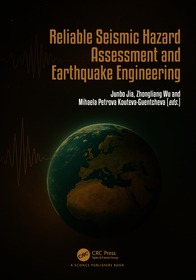
Reliable Seismic Hazard Assessment and Earthquake Engineering
-
10% KEDVEZMÉNY?
- Kiadói listaár GBP 124.99
-
56 432 Ft (53 745 Ft + 5% áfa)
Az ár azért becsült, mert a rendelés pillanatában nem lehet pontosan tudni, hogy a beérkezéskor milyen lesz a forint árfolyama az adott termék eredeti devizájához képest. Ha a forint romlana, kissé többet, ha javulna, kissé kevesebbet kell majd fizetnie.
- Kedvezmény(ek) 10% (kb. 5 643 Ft)
- Kedvezményes ár 50 789 Ft (48 371 Ft + 5% áfa)
50 789 Ft

Beszerezhetőség
Még nem jelent meg, de rendelhető. A megjelenéstől számított néhány héten belül megérkezik.
Why don't you give exact delivery time?
A beszerzés időigényét az eddigi tapasztalatokra alapozva adjuk meg. Azért becsült, mert a terméket külföldről hozzuk be, így a kiadó kiszolgálásának pillanatnyi gyorsaságától is függ. A megadottnál gyorsabb és lassabb szállítás is elképzelhető, de mindent megteszünk, hogy Ön a lehető leghamarabb jusson hozzá a termékhez.
A termék adatai:
- Kiadás sorszáma 1
- Kiadó CRC Press
- Megjelenés dátuma 2026. szeptember 29.
- ISBN 9781041112983
- Kötéstípus Keménykötés
- Terjedelem332 oldal
- Méret 254x178 mm
- Nyelv angol
- Illusztrációk 176 Illustrations, black & white; 116 Halftones, black & white; 60 Line drawings, black & white; 25 Tables, black & white 700
Kategóriák
Rövid leírás:
This commemorative volume honours the 80th birthday of Professor Giuliano F. Panza, a pioneering figure whose work revolutionized seismic hazard assessment through the development of NDSHA. The book integrates theoretical insights and global case studies in seismology, lithospheric modelling, and earthquake engineering.
TöbbHosszú leírás:
This book celebrates the scientific legacy of Professor Giuliano F. Panza. His groundbreaking development of Neo-Deterministic Seismic Hazard Assessment (NDSHA), which resulted in the Panza-Rugarli empirical law, has reshaped how researchers model earthquake ground motion through physically realistic, transparent, and reproducible methodologies. The volume brings together nineteen scholarly contributions from international researchers whose work extends, enhances, or has been directly inspired by Professor Panza's methodologies and mentorship. Organized into theoretical frameworks and practical case studies, the chapters explore seismic-wave modelling, lithospheric structure, NDSHA applications, earthquake engineering, and multi-hazard interactions.
This book is intended for seismologists, geophysicists, earthquake engineers, hazard-assessment practitioners, graduate students, and policymakers seeking a deeper understanding of physics-based seismic hazard approaches.
Key Features:
- Celebrates the illustrious career and invaluable contributions of Professor Giuliano F. Panza.
- Includes contributions by well-known scientists in the field.
- Presents state-of-the-art knowledge in this area.
- Covers a large scope of topics.
- Addresses researchers, engineers and university graduate students.
Tartalomjegyzék:
Preface. PART I: THEORETICAL FRAMEWORKS. 1. Earthquake Forecast/Prediction: What?s Next for Science? 2. Toward a Resilient Nation: The Importance of Seismic Hazard Assessment. 3. Unraveling Fractal Characteristics of Seismogenic Nodes. 4. Seismic Wave Propagation and Soil-structure Interaction via Boundary Integral Equations. 5. Selection of Proper Signals for Nonlinear Time Histories of Structures in the Frame of NDSHA. 6. How Many Sources Must A Man Write Down Before You Call Him A Seismologist? 7. Can The Profile of A High-profile Seismologist Perturb A Ground-shaking Scenario? PART II: PRACTICAL IMPLEMENTATIONS AND CASE STUDIES.? 8. Recent Seismicity of the West African Region. 9. Application of Bicharacteristic Curves of Body and Surface Waves in Geophysics. 10. NDSHA (Fault- and Physics-based) Based Ground Motion Modelling for the City of Plovdiv, Bulgaria. 11. Neo-Deterministic Seismic Hazard Assessment (NDSHA) Applied to Seismic Response Analyses: The Case Study of Chieti?s Hill (Italy). 12. Lithospheric Structure below Seismic Stations in the East of Cuba, from the Cross-correlation Dispersion Analysis and Its Joint Inversion with Receiver Functions. 13. Seismogenic Nodes in South Europe. 14. Deterministic Seismic Hazard Computations (Hybrid Method) Applied for Two Cities in the Territory of Hungary. 15. Seismic Hazard Computation for Egypt Based on the Design Magnitude Mdesign. 16. Research on Three-dimensional Elastoplastic Response Spectra for Seismic Isolated Structures. 17. Dynamic Response and Shear Characteristics of Rubber Fiber Reinforced Calcareous Sand. 18. Energy-Based Engineering Analysis Applied to Physics-based Seismic Time Histories: A Case Study. 19. The Effect of The Eastern Mediterranean Offshore Seismogenic Zones on the Seismic Hazard Assessment of The Lebanese Restraining Bend. 20. Time-dependent Seismic Hazard Assessment and its Application in Earthquake Early Warning System: A Case Study in the China Seismic Experimental Site (CSES).
Több
