

-
10% KEDVEZMÉNY?
- Kiadói listaár GBP 245.00
-
110 617 Ft (105 350 Ft + 5% áfa)
Az ár azért becsült, mert a rendelés pillanatában nem lehet pontosan tudni, hogy a beérkezéskor milyen lesz a forint árfolyama az adott termék eredeti devizájához képest. Ha a forint romlana, kissé többet, ha javulna, kissé kevesebbet kell majd fizetnie.
- Kedvezmény(ek) 10% (cc. 11 062 Ft off)
- Kedvezményes ár 99 556 Ft (94 815 Ft + 5% áfa)
99 556 Ft

Beszerezhetőség
Még nem jelent meg, de rendelhető. A megjelenéstől számított néhány héten belül megérkezik.
Why don't you give exact delivery time?
A beszerzés időigényét az eddigi tapasztalatokra alapozva adjuk meg. Azért becsült, mert a terméket külföldről hozzuk be, így a kiadó kiszolgálásának pillanatnyi gyorsaságától is függ. A megadottnál gyorsabb és lassabb szállítás is elképzelhető, de mindent megteszünk, hogy Ön a lehető leghamarabb jusson hozzá a termékhez.
A termék adatai:
- Kiadás sorszáma 1
- Kiadó Routledge
- Megjelenés dátuma 2026. szeptember 28.
- ISBN 9781032812878
- Kötéstípus Keménykötés
- Terjedelem760 oldal
- Méret 246x174 mm
- Nyelv angol
- Illusztrációk 75 Illustrations, black & white; 75 Halftones, black & white; 12 Tables, black & white 0
Kategóriák
Rövid leírás:
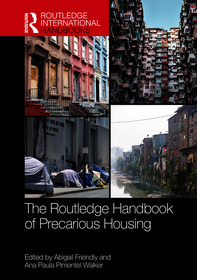
The Routledge Handbook of Precarious Housing offers the first comprehensive, interdisciplinary examination of one of today’s most urgent global challenges: the growing normalization of insecure, unaffordable, and uninhabitable housing.
Több
Hosszú leírás:
The Routledge Handbook of Precarious Housing offers the first comprehensive, interdisciplinary examination of one of today’s most urgent global challenges: the growing normalization of insecure, unaffordable, and uninhabitable housing.
Bringing together leading scholars from across the world, the volume exposes precarious housing not as an exceptional crisis, but as a patterned outcome of financialized, racialized, and post‑settler‑colonial settlements. Through wide‑ranging theoretical reflections and case studies—from social housing and rental markets to informal settlements, climate‑exposed neighbourhoods, migrant housing, and student accommodation—the book illuminates how precariousness is produced both structurally and experientially, shaping dwelling through uncertainty, waiting, instability, and everyday improvisation. Organized around key themes including tenure security, infrastructure, homelessness and health, climate change, predatory actors, social movements, and examples of policies and programs that address precarious housing, the Handbook develops a shared conceptual grammar rooted in temporality, uncertainty, urgency, and collective action. It reveals precarious housing as a terrain of struggle where residents, activists, planners, and policymakers contest dispossession, experiment with alternative forms of dwelling, and reimagine more just futures.
Essential reading for scholars, practitioners, and advocates, this Handbook reframes precarious housing as a central site through which the politics of habitability, governance, and radical justice are negotiated today.
"Friendly and Pimentel Walker have assembled an outstanding collection of critical interventions on key dimensions of precarious housing, from climate change to health. This handbook will be essential reading for activists, scholars, and policymakers seeking to understand one of the most complex and pressing social issues in contemporary capitalism."
-- Susanne Soederberg, author of Urban Displacements and Canada Research Chair in Just and Inclusive Cities at Queen’s University, Canada.
"This carefully crafted volume offers a timely and profound examination of housing precarity across a myriad of global contexts. The book goes beyond simply identifying problems; it also provides forward-looking insights and strategies for achieving housing justice, making it essential reading for scholars, practitioners, and policymakers. By bridging disciplines and geographies, Friendly and Pimentel Walker establish a compelling and much-needed framework for understanding and addressing one of the most pressing urban challenges of our time."
-- Deden Rukmana, Professor and Director, Master of City and Regional Planning Program, Department of Public Affairs and Planning, University of Texas at Arlington.
"The housing crisis is increasingly at the centre of city, national, and global policy discussions. This impressive collection extends the conversation to look beyond just “shortages” to the broader experience of precariousness, while also deepening the analysis of how this is produced in a wide range of settings. It is an invaluable resource to all who seek to understand the multiple dimensions of shelter and who seek opportunities to enable transformative change."
-- David Dodman, General Director, Institute for Housing and Urban Development Studies (IHS).
"This Handbook offers a must-read contribution to housing justice and its literature by providing both conceptual clarity and a plurality of global perspectives on precarious housing. Its diverse contributors show the persistence and challenges of precarious housing but also its remarkable political potential as a site of agency."
-- Vinit Mukhija, Professor, Department of Urban Planning, Founding Director, Master of Real Estate Development (MRED) Program, UCLA Luskin School of Public Affairs.
"The authors and editors of the Handbook of Precarious Housing show the global housing crisis to be anything but a temporary blip of market failure. They demonstrate that housing precarity is endemic across nations and time and requires fundamental rethinking of how housing is produced and allocated. The promising examples of innovative housing solutions given from many countries explore possibilities that need to be discussed broadly."
-- Bruce Stiftel, FAICP, Professor Emeritus, Georgia Institute of Technology.
"Bringing together global perspectives across disciplines and regions, the Handbook of Precarious Housing reconceptualizes housing insecurity as not an exception but a structural feature of contemporary urbanization. From tenure insecurity and homelessness to financialization, coloniality, austerity, climate vulnerability, and intersecting inequalities, the volume develops a powerful and shared conceptual grammar for understanding how precarious housing is produced (and contested) across the Global North and South. By foregrounding both structural forces and everyday practices of dwelling, resistance, and care, the handbook positions precarious housing as a central lens for interpreting urban inequality and imagining more just housing futures. This handbook offers an essential reference for scholars, planners, policymakers, and advocates seeking to understand--and transform—the political economy of housing insecurity today."
-- Karen Chapple, Director of the School of Cities and Professor of Geography and Planning, University of Toronto.
Több
Tartalomjegyzék:
Precarity by design: Global perspectives on precarious housing
Section 1: Key issues of precarious housing amidst rights, informality and justice
1. Causes of precariousness in housing
2. The making and unmaking of housing and urban precarity
3. Housing precarity and the financialization of renting
4. Housing, Climate Change and Informal Settlements: Pathways for Adaptation, Mitigation and Climate Justice
5. Precarious housing in the unequal city through the lens of Johannesburg and the Stjwetla ‘informal’ settlement
6. Informality as governance technology: Precarious housing and the politics of differentiated citizenship
7. How four housing policy instruments affect housing precarity
8. Housing justice: Towards an actionable agenda to tackle housing precarity
9. Evictions and precarious housing
10. Subprime masculinities: Gendering homeownership, mortgage debt and default in 21st century Spain
11. Fragility of homeownership: State-led urban redevelopment and housing precarity
12. Caretaking as tenure: Maintenance as a strategy for precarious inhabitation
13. Flexible planning and the institutionalization of housing precarity: Temporary housing in the Netherlands and Switzerland
Section 3: Homelessness and health
14. At the far end of precarity: Homelessness in the US and responses from the San Diego region
15. Precarious initial reception and refugee shelter insecurity in Toronto
16. Beyond treatment: The failing politics of care and housing precarity among PALOP patients in Portugal
17. Precarious housing and the risk of Chagas disease transmission in rural areas in a Colombian municipality
Section 4: Infrastructure provision
18. Housing and infrastructure precarity
19. Precarity at the housing-water nexus
20. Urban mobility and housing: The role of mobility on urban precariousness
21. Energy and transport poverty as drivers of housing precarity: A multidimensional analysis
22. The intersections between water, sanitation, hygiene (WASH) and housing access in urban slums in Pune, India
23. Between precarious housing and data precariousness: How Rio de Janeiro’s favelas organized themselves to survive the Covid-19 pandemic
24. The infrastructural life of rental housing: Landlord mediation and the production of precarity
25. Intersectionality of climate risk, precarious housing and social (in)justice in Indonesia
26. Invisible climate warriors: Women and LGBTQIA+ experiences against climate displacement in favelas and land occupations
27. Reclaiming space, rights and resources: Climate adaptation in Curitiba’s precarious housing between global agendas and local realities
28. Heat, Housing, and Harm: The Structural Violence of Indoor Thermal Precarity in Colombia
29. Rethinking post-disaster recovery through Sen’s Capability Approach: Housing Reconstruction after the 2015 Nepal Earthquake
Section 6: Predatory actors and practices
30. Precarious housing and Crime
31. Housing volatility in the making of the new capital city in Indonesia
32. Housing microfinance in precarious urban communities: Narratives, actors and contradictions
33. Gentrification and gentefication in post-disaster Puerto Rico: Stories of resilience and struggle
Section 7: Social movements and collective action
34. From precarious housing squatters to city makers: The Movimento per Il Diritto AllÁbitare in Rome
35. Housing precarization and the struggles of tenants: Building solidarities in times of crises
36. Peripheral struggles for housing in Chile: The Pobladores Movement
37. Beyond evictions: Analysing tactics and strategies of international anti-eviction movements
Section 8: Equity, justice, and inclusion
38. Imposed impermanence: Housing precarity, property, and racial capitalism
39. Racial discrimination and housing precarity in U.S. peri-urban areas: The case of a North Texas unincorporated subdivision
40. Precarious housing expanded: Materiality, bureaucracy, and climate in remote Australia
41. Housing precariousness in Sweden: Highlighting the experiences of women with temporary housing solutions
42. Un/earthing phantom homes: LGBTQ+ student-imaginaries transforming othered home-worlds into being
43. Students and housing precarity
44. Urban village and migrant housing in Shenzhen, China
45. Growing housing precarity amongst older people in homeowner nations
Section 9: Solutions to precarious housing
46. A remedy to housing precarity? The potential and limitations of social housing
47. When owning a home is not enough: The promises and pitfalls of subsidized homeownership in Chile
48. Precarious improvements: Lessons from state-sponsored slum upgrading in Southeast Asia
49. Brazilian favelas: Background and policy challenges
50. Addressing housing needs for low income households in Africa: Lessons from experience
51. From precarity to permanence: Housing rights, resistance and renewal through the Caño Martín Peña community land trust in Puerto Rico
52. Collaborative housing as a strategy to address housing precarity and restore housing as a fundamental human right
Conclusion
Precarious housing: Towards a shared conceptual grammar
Több
