

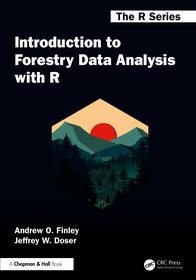
Introduction to Forestry Data Analysis with R
Sorozatcím: Chapman & Hall/CRC The R Series;
-
10% KEDVEZMÉNY?
- Kiadói listaár GBP 62.99
-
28 439 Ft (27 085 Ft + 5% áfa)
Az ár azért becsült, mert a rendelés pillanatában nem lehet pontosan tudni, hogy a beérkezéskor milyen lesz a forint árfolyama az adott termék eredeti devizájához képest. Ha a forint romlana, kissé többet, ha javulna, kissé kevesebbet kell majd fizetnie.
- Kedvezmény(ek) 10% (kb. 2 844 Ft)
- Kedvezményes ár 25 595 Ft (24 377 Ft + 5% áfa)
25 595 Ft

Beszerezhetőség
Még nem jelent meg, de rendelhető. A megjelenéstől számított néhány héten belül megérkezik.
Why don't you give exact delivery time?
A beszerzés időigényét az eddigi tapasztalatokra alapozva adjuk meg. Azért becsült, mert a terméket külföldről hozzuk be, így a kiadó kiszolgálásának pillanatnyi gyorsaságától is függ. A megadottnál gyorsabb és lassabb szállítás is elképzelhető, de mindent megteszünk, hogy Ön a lehető leghamarabb jusson hozzá a termékhez.
A termék adatai:
- Kiadás sorszáma 1
- Kiadó Chapman and Hall
- Megjelenés dátuma 2026. szeptember 25.
- ISBN 9781032120270
- Kötéstípus Puhakötés
- Terjedelem624 oldal
- Méret 254x178 mm
- Súly 453 g
- Nyelv angol
- Illusztrációk 93 Illustrations, color; 93 Line drawings, color; 20 Tables, black & white; 20 Tables, color 700
Kategóriák
Rövid leírás:
As forestry, ecology, and natural resource management become increasingly data-driven, professionals are expected not only to collect information but also to organize, analyze, visualize, and defend quantitative results.
TöbbHosszú leírás:
Introduction to Forestry Data Analysis with R equips students and practitioners with the skills needed to move confidently between field measurements and modern analytical workflows. As forestry, ecology, and natural resource management become increasingly data-driven, professionals are expected not only to collect information but also to organize, analyze, visualize, and defend quantitative results. This book responds to that shift by integrating foundational forest inventory concepts with practical computing in R.
Distinct from both generic programming texts and traditional mensuration references, this volume teaches R through real forestry datasets and operational examples. The first half develops core programming skills—data wrangling, visualization, and reproducible workflows—while the second half applies these tools to forest inventory, monitoring, and estimation. Classical methods developed by forest biometricians are presented alongside transparent, step-by-step computational implementations, enabling readers to connect statistical theory with modern, repeatable analysis.
Key Features:
- Introduces R and the tidyverse using forestry-specific datasets and management questions
- Develops reproducible workflows for data import, cleaning, transformation, visualization, and reporting
- Presents forest inventory concepts including simple random, systematic, stratified, cluster, and multistage sampling
- Implements classical estimators using script-based computing
- Integrates spatial data handling and mapping for areal sampling frames and field-based applications
- Emphasizes practical problem-solving, code organization, and analytical habits that scale from single stands to large inventories
Introduction to Forestry Data Analysis with R is intended for undergraduate and graduate students in forestry, natural resources, and environmental science, as well as practitioners seeking to modernize and streamline their analytical workflows. Whether readers are learning R for the first time or adapting established inventory methods to contemporary datasets, it provides a clear, practical, and reproducible foundation for data-driven forest analysis.
TöbbTartalomjegyzék:
1 Overviewandmotivating data. 2 Introduction to R and RStudio. 3 Scripts and reproducibleworkflows. 4 Data structures. 5 Functions and functional programming. 6 Data summary and analysiswith tidyverse. 7 Manipulating and summarizing datawith dplyr. 8 Tidying datawith tidyr. 9 Creating graphicswith ggplot2. 10 Preliminary definitions and concepts. 11 Basic statistical concepts. 12 Estimating forest parameters. 13 Sampling designs and estimation in forest inventory. 15 Stratified sampling. 16 Estimation using covariates. 17 Cluster sampling. 18 Multistage sampling.
Több
