

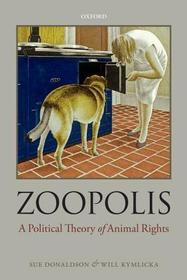
Zoopolis
A Political Theory of Animal Rights
- Publisher's listprice GBP 31.49
-
14 217 Ft (13 540 Ft + 5% VAT)
The price is estimated because at the time of ordering we do not know what conversion rates will apply to HUF / product currency when the book arrives. In case HUF is weaker, the price increases slightly, in case HUF is stronger, the price goes lower slightly.
- Discount 10% (cc. 1 422 Ft off)
- Discounted price 12 795 Ft (12 186 Ft + 5% VAT)
Subcribe now and take benefit of a favourable price.
Subscribe
14 217 Ft

Availability
printed on demand
Why don't you give exact delivery time?
Delivery time is estimated on our previous experiences. We give estimations only, because we order from outside Hungary, and the delivery time mainly depends on how quickly the publisher supplies the book. Faster or slower deliveries both happen, but we do our best to supply as quickly as possible.
Product details:
- Publisher OUP Oxford
- Date of Publication 23 May 2013
- ISBN 9780199673018
- Binding Paperback
- No. of pages352 pages
- Size 233x161x18 mm
- Weight 532 g
- Language English 0
Categories
Short description:
For many people "animal rights" suggests campaigns against factory farms, vivisection or other aspects of our woeful treatment of animals. Zoopolis moves beyond this familiar terrain, focusing not on what we must stop doing to animals, but on how we can establish positive and just relationships with different types of animals.
MoreLong description:
Zoopolis offers a new agenda for the theory and practice of animal rights. Most animal rights theory focuses on the intrinsic capacities or interests of animals, and the moral status and moral rights that these intrinsic characteristics give rise to. Zoopolis shifts the debate from the realm of moral theory and applied ethics to the realm of political theory, focusing on the relational obligations that arise from the varied ways that animals relate to human societies and institutions. Building on recent developments in the political theory of group-differentiated citizenship, Zoopolis introduces us to the genuine "political animal". It argues that different types of animals stand in different relationships to human political communities. Domesticated animals should be seen as full members of human-animal mixed communities, participating in the cooperative project of shared citizenship. Wilderness animals, by contrast, form their own sovereign communities entitled to protection against colonization, invasion, domination and other threats to self-determination. "Liminal" animals who are wild but live in the midst of human settlement (such as crows or raccoons) should be seen as "denizens", resident of our societies, but not fully included in rights and responsibilities of citizenship. To all of these animals we owe respect for their basic inviolable rights. But we inevitably and appropriately have very different relations with them, with different types of obligations. Humans and animals are inextricably bound in a complex web of relationships, and Zoopolis offers an original and profoundly affirmative vision of how to ground this complex web of relations on principles of justice and compassion.
In this careful, thoughtful, and engaging work, Sue Donaldson and Will Kymlicka affirm and extend the attribution of rights to animals. ... The book is thoroughly researched and engages a lot of literature about animals, both philosophical and sociological
Table of Contents:
Introduction
Part I: An Expanded Theory of Animal Rights
Universal Basic Rights for Animals
Expanding ART via Citizenship Theory
Part II: Applications
Domesticated Animals within ART
Domesticated Animal Citizens
Wild Animal Sovereignty
Liminal Animal Denizens
Conclusion

