

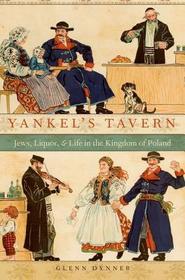
Yankel's Tavern
Jews, Liquor, and Life in the Kingdom of Poland
- Publisher's listprice GBP 39.99
-
18 055 Ft (17 195 Ft + 5% VAT)
The price is estimated because at the time of ordering we do not know what conversion rates will apply to HUF / product currency when the book arrives. In case HUF is weaker, the price increases slightly, in case HUF is stronger, the price goes lower slightly.
- Discount 10% (cc. 1 806 Ft off)
- Discounted price 16 249 Ft (15 476 Ft + 5% VAT)
Subcribe now and take benefit of a favourable price.
Subscribe
18 055 Ft

Availability
printed on demand
Why don't you give exact delivery time?
Delivery time is estimated on our previous experiences. We give estimations only, because we order from outside Hungary, and the delivery time mainly depends on how quickly the publisher supplies the book. Faster or slower deliveries both happen, but we do our best to supply as quickly as possible.
Product details:
- Publisher OUP USA
- Date of Publication 15 January 2015
- ISBN 9780190204143
- Binding Paperback
- No. of pages272 pages
- Size 231x171x15 mm
- Weight 399 g
- Language English
- Illustrations 11 illustrations 0
Categories
Short description:
In Yankel's Tavern, Glenn Dynner investigates the role of Jews in tavern-keeping in the Kingdom of Poland between 1815 and the uprising of 1863-4 and its aftermath.
MoreLong description:
In nineteenth-century Eastern Europe, the Jewish-run tavern was often the center of leisure, hospitality, business, and even religious festivities. As liquor became the region's boom industry, Jewish tavernkeepers became integral to both local economies and local social life, presiding over Christian celebrations and dispensing advice, medical remedies and loans. Nevertheless, reformers and government officials, blaming Jewish tavernkeepers for epidemic peasant drunkenness, sought to drive Jews out of the liquor trade. Their efforts were particularly intense and sustained in the Kingdom of Poland. Historians have assumed that this spelled the end of the Polish Jewish liquor trade. However, in Yankel's Tavern, Glenn Dynner uses newly discovered archival sources to demonstrate that many nobles helped their Jewish tavernkeepers evade fees, bans, and expulsions by installing Christians as fronts for their taverns. The result-a vast underground Jewish liquor trade-reflects an impressive level of local Polish-Jewish co-existence that contrasts with the more familiar story of anti-Semitism and violence.
Glenn Dynner has written a history of Jewish tavern keepers that serves as a point of entry into a much broader challenge to a surprisingly diverse swath of conventional wisdom about Jewish life in the Polish lands of the Russian Empire. For this reason, Yankel s Tavern should be required reading for anyone interested in Jewish history, Polish history, Russian imperial history, nationalism and national identity, and the economic history of eastern Europe. Without ever adopting an aggressive or polemical tone, Dynner has launched several debates that are sure to continue for years to come....[Dynner]offers a story of nuance and complexity, one that defies any attempt to squeeze it into the simplistic dualities that have long weakened both Polish and Jewish history. This alone should place Yankel's Tavern on everyone's must-read list.
Table of Contents:
Author's Preface
A Note on Translations
Introduction
Chapter 1: Entrance: Myths and Countermyths
Chapter 2: Rural Jewish Prohibition in the Kingdom of Poland
Chapter 3: The Urban Jewish Liquor Trade in the Kingdom of Poland
Chapter 4: Patriots, Smugglers and Spies: Tavernkeepers during the Polish Uprisings of 1830 and 1863
Chapter 5: The Tavernkeepers Speak: Polish Jewish Tavernkeeping in the Wake of Peasant Emancipation
Chapter 6: Farmers, Soldiers, and Students: Attempts to Transform Jewish Tavernkeepers
Conclusion
Notes
Bibliography
Index

