

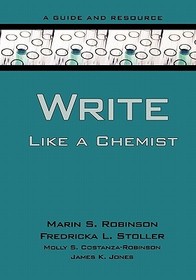
Write Like a Chemist
A Guide and Resource
- Publisher's listprice GBP 99.00
-
44 698 Ft (42 570 Ft + 5% VAT)
The price is estimated because at the time of ordering we do not know what conversion rates will apply to HUF / product currency when the book arrives. In case HUF is weaker, the price increases slightly, in case HUF is stronger, the price goes lower slightly.
- Discount 10% (cc. 4 470 Ft off)
- Discounted price 40 229 Ft (38 313 Ft + 5% VAT)
Subcribe now and take benefit of a favourable price.
Subscribe
44 698 Ft

Availability
printed on demand
Why don't you give exact delivery time?
Delivery time is estimated on our previous experiences. We give estimations only, because we order from outside Hungary, and the delivery time mainly depends on how quickly the publisher supplies the book. Faster or slower deliveries both happen, but we do our best to supply as quickly as possible.
Product details:
- Publisher OUP USA
- Date of Publication 14 August 2008
- ISBN 9780195367423
- Binding Hardback
- No. of pages720 pages
- Size 249x180x38 mm
- Weight 1361 g
- Language English
- Illustrations tables and figures 0
Categories
Long description:
Write Like a Chemist is a unique guide to chemistry-specific writing. Written with National Science Foundation support and extensively piloted in chemistry courses nationwide, it offers a structured approach to writing that targets four important chemistry genres: the journal article, conference abstract, scientific poster, and research proposal. Chemistry students, post-docs, faculty, and other professionals interested in perfecting their disciplinary writing will find it an indispensable reference. Users of the book will learn to write through a host of exercises, ranging in difficulty from correcting single words and sentences to writing professional-quality papers, abstracts, posters, and proposals. The book's read-analyze-write approach teaches students to analyze what they read and then write, paying attention to audience, organization, writing conventions, grammar, and science content, thereby turning the complex process of writing into graduated, achievable tasks. Concise writing and organizational skills are stressed throughout, and "move structures" teach students conventional ways to present their stories of scientific discovery. This resource includes over 350 excerpts from ACS journal articles, ACS conference abstracts, and successful NSF CAREER proposals, excerpts that will serve as useful models of chemistry writing for years to come.
Anyone teaching a college course in professional writing for chemistry students would do well to consider using this thorough, detailed, and systematic book as the textbook. It offers excellent support for students and a solid framework for teachers. Enterprising students who don't have access to a course could profitably use this book on their own, too. Robinson and colleagues have succeeded in producing the "guide and resource" promised in their subtitle for chemists who write - a strong contender for the definitive book in the field.
Table of Contents:
Section One: Writing Modules
Learning to Write Like a Chemist
Module 1The Journal Article
Overview of the Journal Article
Writing the Methods Section
Writing the Results Section
Writing the Discussion
Writing the Introduction
Writing the Abstract and Title
Module 2The Scientific Poster
Writing the Conference Abstract
Writing the Poster Text and Title
Designing the Poster
Module 3The Research Proposal
Overview of the Research Proposal
Writing the Goals and Importance Section
Writing the Proposed Methodology Section
Writing the Outcomes and Impacts Section
Writing the Project Summary and Title
Section Two: Graphics and Citations
Formatting Figures, Tables, and Schemes
Formatting Citations and References
Finalizing Your Written Work
Appendix A - Language Tips
Appendix B - Move Structures
References
Index

