

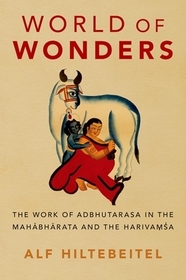
World of Wonders
The Work of Adbhutarasa in the Mahabharata and the Harivamsa
- Publisher's listprice GBP 98.00
-
44 247 Ft (42 140 Ft + 5% VAT)
The price is estimated because at the time of ordering we do not know what conversion rates will apply to HUF / product currency when the book arrives. In case HUF is weaker, the price increases slightly, in case HUF is stronger, the price goes lower slightly.
- Discount 20% (cc. 8 849 Ft off)
- Discounted price 35 398 Ft (33 712 Ft + 5% VAT)
- Discount is valid until: 30 June 2026
Subcribe now and take benefit of a favourable price.
Subscribe
44 247 Ft

Availability
Estimated delivery time: In stock at the publisher, but not at Prospero's office. Delivery time approx. 3-5 weeks.
Not in stock at Prospero.
Why don't you give exact delivery time?
Delivery time is estimated on our previous experiences. We give estimations only, because we order from outside Hungary, and the delivery time mainly depends on how quickly the publisher supplies the book. Faster or slower deliveries both happen, but we do our best to supply as quickly as possible.
Product details:
- Publisher OUP USA
- Date of Publication 31 May 2022
- ISBN 9780197538227
- Binding Hardback
- No. of pages368 pages
- Size 163x237x29 mm
- Weight 653 g
- Language English 208
Categories
Short description:
In World of Wonders, Alf Hiltebeitel addresses the Mahabharata and its supplement, the Harivamsa, through the critical lens of the Indian aesthetic theory of rasa, "juice, essence, or taste." Rejecting the traditional reading of these texts, he argues that the dominant rasa is adbhutarasa, the "mood of wonder." The heart of his argument is that the Mahabharata and Harivamsa both deploy the terms for "wonder" and "surprise" (vismaya) in significant numbers that extend into every facet of these heterogeneous texts, showing how adbhutarasa is at work in the rich and contrasting textual strategies which are integral to the structure of the two texts.
MoreLong description:
In World of Wonders, Alf Hiltebeitel addresses the Mahabharata and its supplement, the Harivamsa, as a single literary composition. Looking at the work through the critical lens of the Indian aesthetic theory of rasa, "juice, essence, or taste," he argues that the dominant rasa of these two texts is adbhutarasa, the "mood of wonder." While the Mahabharata signposts whole units of the text as "wondrous" in its table of contents, the Harivamsa foregrounds a stepped-up term for wonder (ascarya) that drives home the point that Vishnu and Krishna are one.
Two scholars of the 9th and 10th centuries, Anandavardhana and Abhinavagupta, identified the Mahabharata's dominant rasa as santarasa, the "mood of peace." This has traditionally been received as the only serious contestant for a rasic interpretation of the epic. Hiltebeitel disputes both the positive claim that the santarasa interpretation is correct and the negative claim that adbhutarasa is a frivolous rasa that cannot sustain a major work. The heart of his argument is that the Mahabharata and Harivamsa both deploy the terms for "wonder" and "surprise" (vismaya) in significant numbers that extend into every facet of these heterogeneous texts, showing how adbhutarasa is at work in the rich and contrasting textual strategies which are integral to the structure of the two texts.
With this book Hiltebeitel has taken advantage of the artistic licence that his stature permits; but in so doing he has produced a last testament that reflects his intrepid character to a high degree, and that will be treasured by those whose interest in the Mahābhārata he has done so much to encourage and facilitate.
Table of Contents:
Acknowledgments
Introduction: The Work of Adbhutarasa
Chapter 1: Santarasa, Virarasa and the Mahabharata's Two Recensions
Chapter 2: Rasas and Sthayibhavas, Wonders and Surprises
Chapter 3: Adbhutam-Clusters in the Mahabharata: Book 1 to Yudhisthira's Coronation
Chapter 4: Adbhutarasa and Hyperbole: Lessons on Gleaning, Ahimsa, and Bhakti from Bhisma's Postwar Oration
Chapter 5: The Asvamedhika- and Asramavasika-Parvans: The Two Late Postwar Books Called "Wondrous" in the Parvasamgraha
Chapter 6: The Mahabharata's Last Three Books: From the Submergence of Dvaraka to Janamejaya's Last Surprise
Chapter 7: The Harivamsa as a Supplement to the Mahabharata's World of Wonders
Bibliography

