

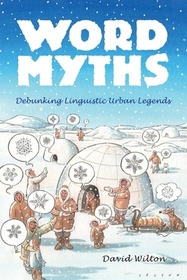
Word Myths
Debunking Linguistic Urban Legends
- Publisher's listprice GBP 12.99
-
5 864 Ft (5 585 Ft + 5% VAT)
The price is estimated because at the time of ordering we do not know what conversion rates will apply to HUF / product currency when the book arrives. In case HUF is weaker, the price increases slightly, in case HUF is stronger, the price goes lower slightly.
- Discount 10% (cc. 586 Ft off)
- Discounted price 5 278 Ft (5 027 Ft + 5% VAT)
Subcribe now and take benefit of a favourable price.
Subscribe
5 864 Ft

Availability
printed on demand
Why don't you give exact delivery time?
Delivery time is estimated on our previous experiences. We give estimations only, because we order from outside Hungary, and the delivery time mainly depends on how quickly the publisher supplies the book. Faster or slower deliveries both happen, but we do our best to supply as quickly as possible.
Product details:
- Publisher OUP USA
- Date of Publication 6 November 2008
- ISBN 9780195375572
- Binding Paperback
- No. of pages240 pages
- Size 201x136x16 mm
- Weight 268 g
- Language English 0
Categories
Short description:
Do you believe that Ring Around the Rosie refers to the Black Death? Or that Eskimos have 50 (or 500) words for "snow"? Or that "Posh" is an acronym for "Port Out, Starboard Home"? If so, you badly need this book. In Word Myths, David Wilton debunks some of the most spectacularly wrong word histories in common usage, giving us the real stories behind many linguistic urban legends.
MoreLong description:
Do you believe that Ring Around the Rosie refers to the Black Death? Or that Eskimos have 50 (or 500) words for "snow"? Or that "Posh" is an acronym for "Port Out, Starboard Home"? If so, you badly need this book. In Word Myths, David Wilton debunks some of the most spectacularly wrong word histories in common usage, giving us the real stories behind many linguistic urban legends.
Readers will discover the true history behind such popular words and expressions such as "rule of thumb," "the whole nine yards," "hot dog," "raining cats and dogs," "chew the fat," "AWOL," "under the weather," "in like Flynn," "Dixie," "son of a gun," "tinker's damn," and many more. We learn that SOS was not originally an acronym for "Save Our Ship" or "Save Our Souls," but was chosen because the morse code signal (3 dots, 3 dashes, 3 dots) was easy to send and recognize. Also, "let the cat out of the bag" does not refer to the whip (the "cat") used to punish sailors aboard ship. The term "upset" (to defeat unexpectedly) does not date from the horse race when the heavily favored Man O' War was beaten by a nag named Upset (Upset was the only horse ever to defeat Man O' War, but the word predates the race by half a century). And Thomas Crapper did not invent the flush toilet, nor do the words "crap" or "crapper" derive from his name.
As Wilton quashes these word myths, he offers us the best of both worlds: not only do we learn the many wrong stories behind these words, we also learn why and how they were created--and what the real story is. "Think 'hot dog' was coined by a New York baseball vendor, or that a certain vulgarity originated as an acronym? Then you need to read this book, which shows that some of the best etymological stories are just tall tales." --Chicago Tribune (10 Best Books About Language, 2004)
"Most everything you know about word and phrase origins is likely to be wrong, and David Wilton proves it with a light touch and a wealth of fascinating case histories. Absolutely everyone with an interest in language will love this book." --J.E. Lighter, Editor, Historical Dictionary of American Slang

