

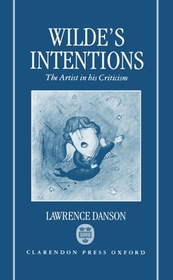
Wilde's Intentions
The Artist in his Criticism
- Publisher's listprice GBP 59.00
-
26 638 Ft (25 370 Ft + 5% VAT)
The price is estimated because at the time of ordering we do not know what conversion rates will apply to HUF / product currency when the book arrives. In case HUF is weaker, the price increases slightly, in case HUF is stronger, the price goes lower slightly.
- Discount 10% (cc. 2 664 Ft off)
- Discounted price 23 975 Ft (22 833 Ft + 5% VAT)
Subcribe now and take benefit of a favourable price.
Subscribe
26 638 Ft

Availability
printed on demand
Why don't you give exact delivery time?
Delivery time is estimated on our previous experiences. We give estimations only, because we order from outside Hungary, and the delivery time mainly depends on how quickly the publisher supplies the book. Faster or slower deliveries both happen, but we do our best to supply as quickly as possible.
Product details:
- Publisher Clarendon Press
- Date of Publication 16 January 1997
- ISBN 9780198183754
- Binding Hardback
- No. of pages208 pages
- Size 224x144x16 mm
- Weight 382 g
- Language English 0
Categories
Short description:
Wilde's Intentions is the first extended study of Oscar Wilde in his role of `the critic as artist'. Lawrence Danson shows how Wilde's essays and dialogues sought to create a new ideal of English culture, elevating what he called `lies' above history and ending the sway of `nature' over liberated human desire.
MoreLong description:
What were Wilde's intentions? They had always been suspect, from the time of Poems, when the charge was plagiarism, to his trials, when the charge was sodomy. In Intentions (1891), the book on which his claim as a theoretical critic chiefly lies, and in two related essays, 'The Portrait of Mr W. H.' and 'The Soul of Man Under Socialism', Wilde's epigrammatic dazzle and paradoxical subversions both reveal and mask his designs upon fin-de-si?cle society. In the first extended study of Wilde's criticism, Lawrence Danson examines these essays/dialogues/fictions (unsettling the categories was one of their intentions) and assesses their achievement. Danson sets Wilde's criticism in context. He shows how the son of an Irish patriot sought to create a new ideal of English culture by elevating 'lies' above history, levelling the distinction between artist and critic, and ending the sway of 'nature' over liberated human desire.
Lawrence Danson's Wilde's Intentions: The Artist and His Criticism provides illuminating and considered readings and contextualizations of Wilde's essays.

