

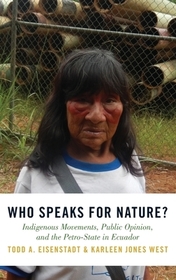
Who Speaks for Nature?
Indigenous Movements, Public Opinion, and the Petro-State in Ecuador
Series: Studies Comparative Energy and Environ;
- Publisher's listprice GBP 90.00
-
40 635 Ft (38 700 Ft + 5% VAT)
The price is estimated because at the time of ordering we do not know what conversion rates will apply to HUF / product currency when the book arrives. In case HUF is weaker, the price increases slightly, in case HUF is stronger, the price goes lower slightly.
- Discount 20% (cc. 8 127 Ft off)
- Discounted price 32 508 Ft (30 960 Ft + 5% VAT)
- Discount is valid until: 30 June 2026
Subcribe now and take benefit of a favourable price.
Subscribe
40 635 Ft

Availability
Estimated delivery time: In stock at the publisher, but not at Prospero's office. Delivery time approx. 3-5 weeks.
Not in stock at Prospero.
Why don't you give exact delivery time?
Delivery time is estimated on our previous experiences. We give estimations only, because we order from outside Hungary, and the delivery time mainly depends on how quickly the publisher supplies the book. Faster or slower deliveries both happen, but we do our best to supply as quickly as possible.
Product details:
- Publisher OUP USA
- Date of Publication 6 June 2019
- ISBN 9780190908959
- Binding Hardback
- No. of pages288 pages
- Size 236x165x30 mm
- Weight 522 g
- Language English 0
Categories
Short description:
Using the first national survey in Ecuador featuring an oversample of Amazon indigenous communities, this path-breaking book argues that how vulnerable or exposed people have been to environmental degradation determines how strongly they feel about saving the environment. Rather than emphasizing ethnic identity or stakeholders' ideological pre-dispositions towards environmentalism, the authors argue that on the front lines of environmental conservation, peoples' views are driven by personal experiences of vulnerability. Using the survey and hundreds of interviews across Ecuador over three years, the authors also argue that the creation of interest groups across ethnic and class lines is more effective in promoting environmental activism than more traditional approaches involving only ethnic or partisan affinity groups.
MoreLong description:
In 2009, Ecuador became the first nation ever to enshrine rights for nature in its constitution. Nature was accorded inalienable rights, and every citizen was granted standing to defend those rights. At the same time, the government advanced a policy of "extractive populism," buying public support for mineral mining by promising that funds from the mining would be used to increase public services.
This book, based on a nationwide survey and interviews about environmental attitudes among citizens as well as indigenous, environmental, government, academic, and civil society leaders in Ecuador, offers a theory about when and why individuals will speak for nature, particularly when economic interests are at stake. Parting from conventional social science arguments that political attitudes are determined by ethnicity or social class, the authors argue that environmental dispositions in developing countries are shaped by personal experiences of vulnerability to environmental degradation. Abstract appeals to identity politics, on the other hand, are less effective. Ultimately, this book argues that indigenous groups should be the stewards of nature, but that they must do so by appealing to the concrete, everyday vulnerabilities they face, rather than by turning to the more abstract appeals of ethnic-based movements.
Based on interviews with 15 gay men from three generations and various ethnic and class backgrounds, this book offers individual stories to humanize existing research on gay male identity formation and health behaviors. The result is an accessible introduction to the lives of gay men and the ways gay coming of age has changed or remained consistent over the course of the last 50 years. The book will be most useful to the general reader or early undergraduate, who can better make sense of existing research with the anecdotal illustrations this book provides. Halkitis emphasizes that identifying oneself as a gay man (that is, coming out) is not a singular act but an ongoing process that, although specific circumstances have changed over time, is consistently necessitated by the dominant society's assumptions that everyone is heterosexual until proven otherwise, and by its macro- and microaggressions against LGBTQ individuals.
Table of Contents:
Acknowledgements
Chapter 1: Beyond Multiculturalism: Vulnerability Politics and the Environment in Latin America
Chapter 2: Multiculturalism Versus Polycentric Pluralism: Vulnerability Challenges Post-Materialist Values on Ecuador's Oil Extraction Frontier
Chapter 3: Does Prior Consultation Diminish Extractive Conflict or Channel It to New Venues? Evidence from Ecuador and the Andes
Chapter 4: Crude Bargaining: Indigenous Ambivalence Regarding Oil Extraction in the Ecuadorian Amazon
Chapter 5: How Science, Religion, and Politics Influence Indigenous Attitudes on Climate Change in Ecuador
Chapter 6: Exploring the Contradiction of Extractive Populism between Domestic and International Politics in Ecuador
Chapter 7: How to Effectively Speak for Nature?
Bibliography
Index

