

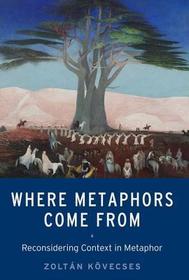
Where Metaphors Come From
Reconsidering Context in Metaphor
- Publisher's listprice GBP 45.99
-
20 764 Ft (19 775 Ft + 5% VAT)
The price is estimated because at the time of ordering we do not know what conversion rates will apply to HUF / product currency when the book arrives. In case HUF is weaker, the price increases slightly, in case HUF is stronger, the price goes lower slightly.
- Discount 10% (cc. 2 076 Ft off)
- Discounted price 18 687 Ft (17 798 Ft + 5% VAT)
Subcribe now and take benefit of a favourable price.
Subscribe
20 764 Ft

Availability
printed on demand
Why don't you give exact delivery time?
Delivery time is estimated on our previous experiences. We give estimations only, because we order from outside Hungary, and the delivery time mainly depends on how quickly the publisher supplies the book. Faster or slower deliveries both happen, but we do our best to supply as quickly as possible.
Product details:
- Publisher OUP USA
- Date of Publication 9 February 2017
- ISBN 9780190656713
- Binding Paperback
- No. of pages232 pages
- Size 231x155x15 mm
- Weight 340 g
- Language English 110
Categories
Short description:
Kövecses recasts CMT as a contextual theory of metaphor, expanding and refining it to account for the ways in which many verbal metaphors are tied to context.
MoreLong description:
In Where Metaphors Come From, Zoltán Kövecses proposes a metaphorical grounding that augments and refines conceptual metaphor theory according to which conceptual metaphors are based on our bodily experience. While this is certainly true in many cases of metaphor, the role of the body in metaphor creation can and should be reinterpreted, and, consequently, the body can be seen as just one of the several contexts from which metaphors can emerge (including the situational, discourse, and conceptual-cognitive contexts) - although perhaps the dominant or crucial one.
Kövecses is a leader in CMT, and his argument in this book is more in line with what has been discovered about the nature of human cognition in recent years; namely, that human cognition is grounded in experience in multiple ways - embodiment, in a strict sense, being just one of them (see Barsalou, 2008; Gibbs, 2006; Pecher and Zwaan, 2005). In light of the present work, this is because cognition, including metaphorical cognition, is grounded in not only the body, but also in the situations in which people act and lead their lives, the discourses in which they are engaged at any time in communicating and interacting with each other, and the conceptual knowledge they have accumulated about the world in the course of their experience of it.
As a discipline, linguistics has many theories about how metaphors shape and are shaped by common experiences and culture. Kövecses expands on traditional conceptual metaphor theory by adding the element of context to the mix... He provides good examples from a variety of contextual and cultural situations and includes several chapters on the cognitive aspects of linguistic humor.
Table of Contents:
Preface
Acknowledgments
Chapter 1: Metaphor, embodiment, and context
Chapter 2: Meaning making
Chapter 3: The conceptual system
Chapter 4: Contextual factors
Chapter 5: Metaphor and culture
Chapter 6: Context and metaphorical creativity
Chapter 7: Context and poetic metaphor
Chapter 8: The conceptual context of linguistic humor
Chapter 9: Happiness in context
Chapter 10: Metaphor and context
References
Index

