

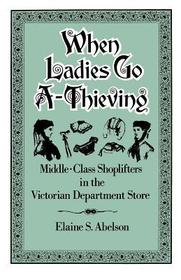
When Ladies Go A-Thieving
Middle-Class Shoplifters in the Victorian Department Store
- Publisher's listprice GBP 49.99
-
22 570 Ft (21 495 Ft + 5% VAT)
The price is estimated because at the time of ordering we do not know what conversion rates will apply to HUF / product currency when the book arrives. In case HUF is weaker, the price increases slightly, in case HUF is stronger, the price goes lower slightly.
- Discount 10% (cc. 2 257 Ft off)
- Discounted price 20 313 Ft (19 346 Ft + 5% VAT)
Subcribe now and take benefit of a favourable price.
Subscribe
22 570 Ft

Availability
printed on demand
Why don't you give exact delivery time?
Delivery time is estimated on our previous experiences. We give estimations only, because we order from outside Hungary, and the delivery time mainly depends on how quickly the publisher supplies the book. Faster or slower deliveries both happen, but we do our best to supply as quickly as possible.
Product details:
- Publisher OUP USA
- Date of Publication 30 April 1992
- ISBN 9780195071429
- Binding Paperback
- No. of pages320 pages
- Size 209x140x24 mm
- Weight 386 g
- Language English
- Illustrations 25 halftones 0
Categories
Short description:
This book focuses on middle-class urban women as participants in new forms of consumer culture. Within the special world of the department store, women found themselves challenged to resist the enticements of comsumption. Many succumbed, buying both what they needed and what they desired, but also stealing what seemed so readily available. Pitted against these middle-class women were the management, detectives, and clerks of the department stores. Abelson argues that in the interest of concealing this darker side of consumerism, women of the middle class, but not those of the working class, were allowed to shoplift and lead incapacitating illness--kleptomania. The invention of kleptomania by psychiatrists and the adoption of this ideology of feminine weakness by retailers, newspapers, the general public, the accused women themselves, and even the courts reveals the way in which a gender analysis allowed proponents of consumer capitalism to mask its contradictions.
MoreLong description:
This book focuses on middle-class urban women as participants in new forms of consumer culture. Within the special world of the department store, women found themselves challenged to resist the enticements of consumption. Many succumbed, buying both what they needed and what they desired, but also stealing what seemed so readily available. Pitted against these middle-class women were the management, detectives, and clerks of the department stores. Abelson argues that in the interest of concealing this darker side of consumerism, women of the middle class, but not those of the working class, were allowed to shoplift and plead incapacitating illness--kleptomania. The invention of kleptomania by psychiatrists and the adoption of this ideology of feminine weakness by retailers, newspapers, the general public, the accused women themselves, and even the courts reveals the way in which a gender analysis allowed proponents of consumer capitalism to mask its contradictions.
"More than a history of social change and shoplifting. It is a study of consumer culture and technological change, class privilege and gender roles in transition, female criminality and social control....Interesting, well-written, and informative."--American Journal of Sociology

