

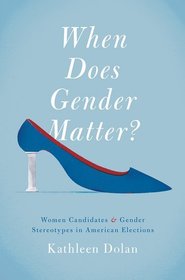
When Does Gender Matter?
Women Candidates and Gender Stereotypes in American Elections
- Publisher's listprice GBP 31.49
-
14 217 Ft (13 540 Ft + 5% VAT)
The price is estimated because at the time of ordering we do not know what conversion rates will apply to HUF / product currency when the book arrives. In case HUF is weaker, the price increases slightly, in case HUF is stronger, the price goes lower slightly.
- Discount 10% (cc. 1 422 Ft off)
- Discounted price 12 795 Ft (12 186 Ft + 5% VAT)
Subcribe now and take benefit of a favourable price.
Subscribe
14 217 Ft

Availability
Uncertain availability. Please turn to our customer service.
Why don't you give exact delivery time?
Delivery time is estimated on our previous experiences. We give estimations only, because we order from outside Hungary, and the delivery time mainly depends on how quickly the publisher supplies the book. Faster or slower deliveries both happen, but we do our best to supply as quickly as possible.
Product details:
- Publisher OUP USA
- Date of Publication 25 September 2014
- ISBN 9780199968282
- Binding Paperback
- No. of pages264 pages
- Size 234x155x17 mm
- Weight 340 g
- Language English
- Illustrations 6 b/w line 0
Categories
Short description:
Scholars and political observers raise concerns that the sex of a woman candidate can complicate her chances of success. This perspective is primarily motivated by concerns about the negative impact of voter gender stereotypes. Instead, this book demonstrates that gender stereotypes have little impact on voter decisions involving women candidates.
MoreLong description:
As the number of women candidates for office in the U.S. increases each election cycle, scholars are confronted with questions about the impact of their sex on their chances of success. Chief among these questions involves the influence of gender stereotypes on the decisions voters make in elections in which women run against men. Previous research documents that voters see women and men as possessing different character traits and different abilities to handle policy issues. These findings, combined with anecdotal evidence of sexist attitudes toward women candidates, raises concerns that women candidates are hampered by their sex and gender considerations. Employing data from an original survey of 3150 U.S. adults conducted in 2010, this book confronts scholarly concerns that gender stereotypes work to undermine women's chances of success. Challenging the conventional wisdom, these data demonstrate that voters do not rely heavily on gender stereotypes when evaluating and voting for women candidates. Voters do hold gendered attitudes, both positive and negative, about women candidates, but these attitudes are not related to the political decisions voters make. Instead, in deciding for whom to vote, people are influenced by traditional political forces, like political party and incumbency, regardless of the sex of the candidates. There is also evidence that partisan stereotypes interact with gender stereotypes to influence reactions to candidates, both women and men, depending on their political party. In the end, this project demonstrates that women candidates win as often as do men and that partisan concerns trump gender every time.
Dolan provides significant suggestions for further analysis, noting a need for a better understanding of the interaction between stereotypes and party preferences, as well as analysis of candidates and stereotyping at the state and local level.
Table of Contents:
Acknowledgements
List of Figures and Tables
Chapter 1 - Candidate Sex and Gender Stereotypes in American Elections
Chapter 2 - Studying Gender Stereotypes and Women Candidates
Chapter 3 - Attitudes, Stereotypes, and Support for Women Candidates
Chapter 4 - Do Stereotypes Shape Evaluations of Candidates?
Chapter 5 - The Role of Stereotypes in Vote Choice Decisions
Chapter 6 - Stereotypes in Other Places? Candidate Quality and Issue Campaigns
Chapter 7 - The Landscape for Women Candidates
Appendix A - Candidate Lists
Appendix B - Variable Construction
Appendix C - Campaign Ads and Websites
Appendix D - Survey Instrument
Appendix E - Additional Vote Choice Analysis
Notes
Bibliography
Index

