

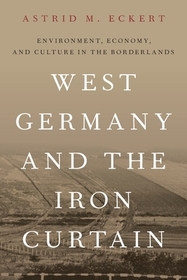
West Germany and the Iron Curtain
Environment, Economy, and Culture in the Borderlands
- Publisher's listprice GBP 29.99
-
13 540 Ft (12 895 Ft + 5% VAT)
The price is estimated because at the time of ordering we do not know what conversion rates will apply to HUF / product currency when the book arrives. In case HUF is weaker, the price increases slightly, in case HUF is stronger, the price goes lower slightly.
- Discount 10% (cc. 1 354 Ft off)
- Discounted price 12 186 Ft (11 606 Ft + 5% VAT)
Subcribe now and take benefit of a favourable price.
Subscribe
13 540 Ft

Availability
Estimated delivery time: In stock at the publisher, but not at Prospero's office. Delivery time approx. 3-5 weeks.
Not in stock at Prospero.
Why don't you give exact delivery time?
Delivery time is estimated on our previous experiences. We give estimations only, because we order from outside Hungary, and the delivery time mainly depends on how quickly the publisher supplies the book. Faster or slower deliveries both happen, but we do our best to supply as quickly as possible.
Product details:
- Publisher OUP USA
- Date of Publication 3 August 2021
- ISBN 9780197582312
- Binding Paperback
- No. of pages440 pages
- Size 163x239x25 mm
- Weight 658 g
- Language English
- Illustrations 11 halftones 179
Categories
Short description:
West Germany and the Iron Curtain takes a fresh look at the history of the Federal Republic and the German re-unification process from the spatial perspective of the West German borderlands that emerged along the volatile inter-German border after 1945. The book is the first environmental history of the Iron Curtain.
MoreLong description:
West Germany and the Iron Curtain takes a fresh look at the history of Cold War Germany and the German reunification process from the spatial perspective of the West German borderlands that emerged along the volatile inter-German border after 1945. These border regions constituted the Federal Republic's most sensitive geographical space where it had to confront partition and engage its socialist neighbor East Germany in concrete ways. Each issue that arose in these borderlands - from economic deficiencies, border tourism, environmental pollution, landscape change, and the siting decision for a major nuclear facility - was magnified and mediated by the presence of what became the most militarized border of its day, the Iron Curtain.
In topical chapters, the book addresses the economic consequences of the border for West Germany, which defined the border regions as depressed areas, and examines the cultural practice of western tourism to the Iron Curtain. At the heart of this deeply-researched book stands an environmental history of the Iron Curtain that explores transboundary pollution, landscape change, and a planned nuclear industrial site at Gorleben that was meant to bring jobs into the depressed border regions. The book traces these subjects across the caesura of 1989/90, thereby integrating the "long" postwar era with the post-unification decades. As Eckert demonstrates, the borderlands that emerged with partition and disappeared with reunification did not merely mirror some larger developments in the Federal Republic's history but actually helped to shape them.
Eckert's book offers a fresh and inspiring look at the history of divided Germany. Rather than stopping at the Iron Curtain, it delves into discussions not only about the discursive and performative creation and consolidation of borders but also about crossborder entanglements.
Table of Contents:
Acknowledgments
Introduction: On the Western Side of Germany's Iron Curtain
1. The Making of the West German Borderlands, 1945-1955
2. The East of the West: An Economic Backwater at the Border
3. "Greetings from the Zonal Border": Tourism to the Iron Curtain
4. Salts, Sewage, and Sulfurous Air: Transboundary Pollution in the Borderlands
5. Transboundary Natures: The Consequences of the Iron Curtain for Landscape
6. Closing the Nuclear Fuel Cycle at Gorleben? West Germany's Energy Future in the Borderlands
Conclusion West Germany from the Periphery
Abbreviations
Notes
Bibliography
Index

