

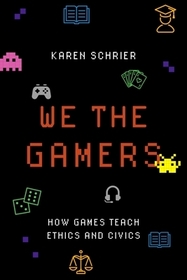
We the Gamers
How Games Teach Ethics and Civics
- Publisher's listprice GBP 33.49
-
15 120 Ft (14 400 Ft + 5% VAT)
The price is estimated because at the time of ordering we do not know what conversion rates will apply to HUF / product currency when the book arrives. In case HUF is weaker, the price increases slightly, in case HUF is stronger, the price goes lower slightly.
- Discount 20% (cc. 3 024 Ft off)
- Discounted price 12 096 Ft (11 520 Ft + 5% VAT)
- Discount is valid until: 30 June 2026
Subcribe now and take benefit of a favourable price.
Subscribe
15 120 Ft

Availability
Estimated delivery time: In stock at the publisher, but not at Prospero's office. Delivery time approx. 3-5 weeks.
Not in stock at Prospero.
Why don't you give exact delivery time?
Delivery time is estimated on our previous experiences. We give estimations only, because we order from outside Hungary, and the delivery time mainly depends on how quickly the publisher supplies the book. Faster or slower deliveries both happen, but we do our best to supply as quickly as possible.
Product details:
- Publisher OUP USA
- Date of Publication 7 September 2021
- ISBN 9780190926113
- Binding Paperback
- No. of pages400 pages
- Size 155x231x25 mm
- Weight 612 g
- Language English 135
Categories
Short description:
Combining research-based perspectives and current examples including Minecraft and Animal Crossing: New Horizons, We the Gamers shows how games can be used in ethics, civics, and social studies education to inspire learning, critical thinking, and civic change.
MoreLong description:
Distrust. Division. Disparity. Is our world in disrepair?
Ethics and civics have always mattered, but perhaps they matter now more than ever before. Recently, with the rise of online teaching and movements like
PlayApartTogether, games have become increasingly acknowledged as platforms for civic deliberation and value sharing. We the Gamers explores these possibilities by examining how we connect, communicate, analyze, and discover when we play games. Combining research-based perspectives and current examples, this volume shows how games can be used in ethics, civics, and social studies education to inspire learning, critical thinking, and civic change.
We the Gamers introduces and explores various educational frameworks through a range of games and interactive experiences including board and card games, online games, virtual reality and augmented reality games, and digital games like Minecraft, Executive Command, Keep Talking and Nobody Explodes, Fortnite, When Rivers Were Trails, Politicraft, Quandary, and Animal Crossing: New Horizons. The book systematically evaluates the types of skills, concepts, and knowledge needed for civic and ethical engagement, and details how games can foster these skills in classrooms, remote learning environments, and other educational settings. We the Gamers also explores the obstacles to learning with games and how to overcome those obstacles by encouraging equity and inclusion, care and compassion, and fairness and justice.
Featuring helpful tips and case studies, We the Gamers shows teachers the strengths and limitations of games in helping students connect with civics and ethics, and imagines how we might repair and remake our world through gaming, together.
Table of Contents:
Contents
Acknowledgments
Part I. Teaching Ethics and Civics
Chapter 1: We the People
Chapter 2: Why Should We Teach Ethics and Civics?
Chapter 3: What Should We Teach?
Part II. Using Games for Knowledge and Action
Chapter 4: What is the Knowledge We Need?
Chapter 5: How Do We Take Real-World Action?
Part III. Using Games for Connection and Community
Chapter 6: How Do We Connect and Communicate?
Chapter 7: How Do We Understand Ourselves and Our Roles in Society?
Chapter 8: How Do We Cultivate Empathy and Respect for Others?
Part IV. Using Games for Critical Thinking and Inquiry
Chapter 9: How Do Make and Reflect on Decisions?
Chapter 10: How Do We Read and Evaluate Information?
Chapter 11: How Do We Analyze Problems and Systems?
Chapter 12: How Do We Explore and Design?
Part V. Games for Ethics and Civics
Chapter 13: Guidelines, Questions, and Considerations
Chapter 14: We the Gamers
Appendix I. Example Lesson Outline 1
Appendix II. Example Lesson Outline 2
Appendix III. Design Toolkit
Appendix IV. Design Principles
Appendix V. Recommendations and Open Questions
Notes
Index

