

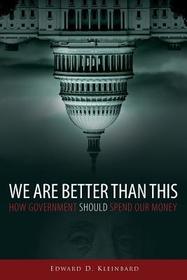
We Are Better Than This
How Government Should Spend Our Money
- Publisher's listprice GBP 30.49
-
13 766 Ft (13 110 Ft + 5% VAT)
The price is estimated because at the time of ordering we do not know what conversion rates will apply to HUF / product currency when the book arrives. In case HUF is weaker, the price increases slightly, in case HUF is stronger, the price goes lower slightly.
- Discount 10% (cc. 1 377 Ft off)
- Discounted price 12 389 Ft (11 799 Ft + 5% VAT)
Subcribe now and take benefit of a favourable price.
Subscribe
13 766 Ft

Availability
printed on demand
Why don't you give exact delivery time?
Delivery time is estimated on our previous experiences. We give estimations only, because we order from outside Hungary, and the delivery time mainly depends on how quickly the publisher supplies the book. Faster or slower deliveries both happen, but we do our best to supply as quickly as possible.
Product details:
- Publisher OUP USA
- Date of Publication 19 May 2016
- ISBN 9780190496685
- Binding Paperback
- No. of pages544 pages
- Size 234x155x25 mm
- Weight 762 g
- Language English 0
Categories
Short description:
In We Are Better Than This, Edward D. Kleinbard explores how budget debates in the United States are overly focused on tax policy. What is missing, according to Kleinbard, is a rational and serious debate about spending policy.
MoreLong description:
We Are Better Than This fundamentally reframes budget debates in the United States. Author Edward D. Kleinbard explains how the public's preoccupation with tax policy alone has obscured any understanding of government's ability to complement the private sector through investment and insurance programs that enhance the general welfare and prosperity of our society at large.
He argues that when we choose how government should spend and tax, we open a window into our "fiscal soul," because those choices are the means by which we express the values we cherish and the regard in which we hold our fellow citizens. Though these values are being diminished by short-sighted decisions to starve government, strategic government spending can directly make citizens happier, healthier, and even wealthier.
Expertly combining the latest economic research with his insider knowledge of the budget process into a simple yet compelling narrative, he unmasks the tax mythologies and false arguments that too often dominate contemporary discourse about budget policies. Large quantities of comparative data are succinctly distilled to situate the United States among its peer countries, so that readers can judge for themselves whether contemporary budget choices really reflect our aspirational fiscal soul.
Kleinbard's presentation takes a multi-disciplinary approach, drawing on economics, finance, law, political science and moral philosophy. He uniquely weaves economic research and moral philosophy together by emphasizing our welfare, not just our national income, and by contrasting the actual beliefs of Adam Smith, a great moral philosopher, with the cartoon version of the man presented by proponents of the most extreme forms of private market triumphalism.
Packed with powerful data, fresh insights, unassailable analysis, and a set of recommendations that are both economically and politically viable... [A] compelling critique of market triumphalism and the economist who helped to shape it."
Washington Post
Table of Contents:
PART I: OUR FISCAL SOUL IN PERIL
Chapter 1: The Happiness of Society
Chapter 2: Our Descent from Moral Philosophy to Narcissism
Chapter 3: Our Dismal Report Card
Chapter 4: Inequality Defenders, Deniers and Dissemblers
Chapter 5: The Growth Fairy
PART II: STARVING OUR FISCAL SOUL
Chapter 6: An Overweight Government?
Chapter 7: Are High Taxes Killing Us?
Chapter 8: The Hidden Hand of Government Spending
Chapter 9: A Field Guide to False Fiscal Crises
PART III: RECLAIMING OUR FISCAL SOUL
Chapter 10: Government Investment
Chapter 11: Government As Insurer
Chapter 12: From Progressive Tax to Progressive Fiscal System
Chapter 13: The Better Base Case
Chapter 14: Conclusion: We Are Better Than This

