

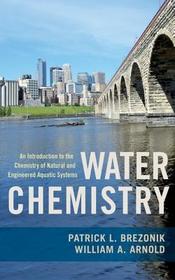
Water Chemistry
An Introduction to the Chemistry of Natural and Engineered Aquatic Systems
- Publisher's listprice GBP 177.50
-
80 141 Ft (76 325 Ft + 5% VAT)
The price is estimated because at the time of ordering we do not know what conversion rates will apply to HUF / product currency when the book arrives. In case HUF is weaker, the price increases slightly, in case HUF is stronger, the price goes lower slightly.
- Discount 10% (cc. 8 014 Ft off)
- Discounted price 72 127 Ft (68 693 Ft + 5% VAT)
Subcribe now and take benefit of a favourable price.
Subscribe
80 141 Ft

Availability
printed on demand
Why don't you give exact delivery time?
Delivery time is estimated on our previous experiences. We give estimations only, because we order from outside Hungary, and the delivery time mainly depends on how quickly the publisher supplies the book. Faster or slower deliveries both happen, but we do our best to supply as quickly as possible.
Product details:
- Publisher OUP USA
- Date of Publication 12 May 2011
- ISBN 9780199730728
- Binding Hardback
- No. of pages808 pages
- Size 170x244x48 mm
- Weight 1451 g
- Language English
- Illustrations 200 illustrations 0
Categories
Short description:
This book provides students with the tools necessary to understand the processes that control the chemical species present in waters of both natural and engineered systems.
MoreLong description:
This book provides students with the tools necessary to understand the processes that control the chemical species present in waters of both natural and engineered systems. After providing basic information about water itself and the chemical composition of water in environmental systems, the text covers the necessary theory (thermodynamics, activity, and kinetics) and background material to solve problems. It emphasizes that both equilibrium and kinetic processes are important in aquatic systems. The book does not merely focus on inorganic constituents, but also on the fate and reactions of organic chemicals.
The solving of quantitative equilibrium and kinetic problems using mathematical, graphical, and computational tools is emphasized throughout presentations on acid-base chemistry, complexation of metal ions, solubility of minerals, and oxidation-reduction reactions. The use of these problem-solving tools is then extended in the presentation of topics relevant to natural systems, including dissolved oxygen, nutrient chemistry, geochemical controls on chemical composition, photochemistry, and natural organic matter. The kinetics and equilibria relevant to engineered systems (e.g., chlorination and disinfection chemistry, sorption and surface chemistry) and organic contaminant chemistry are also discussed. Numerous in-chapter examples that show the application of theory and demonstrate how problems are solved using algebraic, graphical, and computer-based techniques are included. Examples are relevant to both natural waters and engineered systems.
Table of Contents:
Part I. Prologue
Introductory matters
Inorganic chemical composition of natural waters: elements of aqueous geochemistry
Part II. Theory, Fundamentals and Important Tools
The thermodynamic basis for equilibrium chemistry
Activity-concentration relationships
Chemical kinetics
Fundamentals of organic chemistry for environmental systems
Solving ionic equilibria problems
Part III. Inorganic Chemical Equilibria and Kinetics
Acid-base systems in natural waters
Complexation reactions and metal ion speciation
Solubility: reactions of solid phases with water
Redox equilibria and kinetics
Part IV. Chemistry of Natural Waters and Engineered Systems
Dissolved oxygen
Chemistry of chlorine and other disinfectants
Surface chemistry and sorption processes
Aqueous geochemistry II: minor metals (Al, Fe, Mn), silica, minerals and weathering
Nutrient cycles and chemistry: nitrogen and phosphorus
Fundamentals of photochemistry and some applications in aquatic systems
Natural organic matter and aquatic humic substances
Chemical behavior of organic pollutants

