

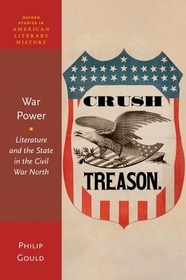
War Power
Literature and the State in the Civil War North
Series: Oxford Studies in American Literary History;
- Publisher's listprice GBP 84.00
-
37 926 Ft (36 120 Ft + 5% VAT)
The price is estimated because at the time of ordering we do not know what conversion rates will apply to HUF / product currency when the book arrives. In case HUF is weaker, the price increases slightly, in case HUF is stronger, the price goes lower slightly.
- Discount 10% (cc. 3 793 Ft off)
- Discounted price 34 133 Ft (32 508 Ft + 5% VAT)
Subcribe now and take benefit of a favourable price.
Subscribe
37 926 Ft

Availability
Estimated delivery time: In stock at the publisher, but not at Prospero's office. Delivery time approx. 3-5 weeks.
Not in stock at Prospero.
Why don't you give exact delivery time?
Delivery time is estimated on our previous experiences. We give estimations only, because we order from outside Hungary, and the delivery time mainly depends on how quickly the publisher supplies the book. Faster or slower deliveries both happen, but we do our best to supply as quickly as possible.
Product details:
- Publisher OUP Oxford
- Date of Publication 20 August 2024
- ISBN 9780198897354
- Binding Hardback
- No. of pages256 pages
- Size 240x160x20 mm
- Weight 542 g
- Language English
- Illustrations 6 black and white illustrations 514
Categories
Short description:
Philip Gould examines nineteenth-century literature in light of the transformation of the federal state's power during the American Civil War. How do literary works engage the subjects of censorship, propaganda, and the reconfigured meanings of "loyalty" and "treason" at a time of political crisis?
MoreLong description:
What happens if we reconsider the literature of the Civil War North in light of the transformation of the federal state's power? While literary scholarship about the Civil War has more generally focused on the rise of wartime nationalism, Philip Gould looks particularly at how literary works engage the subjects of censorship, propaganda, and the reconfigured meanings of "loyalty" and "treason" at a time of political crisis.
During the war the Lincoln Administration shut down opposition newspapers and curtailed free expression and civil liberties protected by the US Constitution. Lincoln also suspended the writ of habeas corpus to deal with political dissenters and try to control public opinion. Early in the war, he coined the phrase "war power" to describe the (presumed) powers to address this crisis; his policies became controversial throughout the conflict. War Power: Literature and the State in the Civil War North considers literary production in this "total war" that radically changed the federal government's (and its military's) relation to traditional norms and spaces of private, domestic, and social life.
Each chapter focuses on a major writer in the Civil War North's engagement with questions of identity, affect, and affiliation: Could one love the Union as one loved home and family? What were the implications for literary expression in the midst of a political culture being reshaped by censorship and propaganda? The final two chapters address the role and plight of African Americans in the Civil War and its aftermath, focusing particularly on African American military service as the supposed means by which racially disenfranchised Americans might become citizens.
War Power offers both insight into what may come, and a sense of how even loyal literary writings, and art more generally, can work to name these federal aggressions and counter state power.
Table of Contents:
List of Illustrations
Acknowledgments
Introduction
Hawthorne and the State of War
Altered Domesticities: Love and Loyalty in Louisa May Alcott's Civil War Fiction
Power, Politics, and the Marriage Plot in the Fiction of John W. De Forest
Race, Violence, and African-American Citizenship
Melville and the Time of War
Epilogue
Notes
Bibliography

