

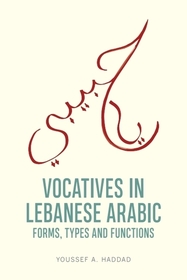
Vocatives in Lebanese Arabic
Forms, Types and Functions
- Publisher's listprice GBP 90.00
-
40 635 Ft (38 700 Ft + 5% VAT)
The price is estimated because at the time of ordering we do not know what conversion rates will apply to HUF / product currency when the book arrives. In case HUF is weaker, the price increases slightly, in case HUF is stronger, the price goes lower slightly.
- Discount 20% (cc. 8 127 Ft off)
- Discounted price 32 508 Ft (30 960 Ft + 5% VAT)
- Discount is valid until: 30 June 2026
Subcribe now and take benefit of a favourable price.
Subscribe
40 635 Ft

Availability
Estimated delivery time: In stock at the publisher, but not at Prospero's office. Delivery time approx. 3-5 weeks.
Not in stock at Prospero.
Why don't you give exact delivery time?
Delivery time is estimated on our previous experiences. We give estimations only, because we order from outside Hungary, and the delivery time mainly depends on how quickly the publisher supplies the book. Faster or slower deliveries both happen, but we do our best to supply as quickly as possible.
Product details:
- Publisher Edinburgh University Press
- Date of Publication 30 April 2026
- ISBN 9781399547659
- Binding Hardback
- No. of pages288 pages
- Size 234x156 mm
- Language English
- Illustrations 8 B&W images 700
Categories
Short description:
What forms and types of vocatives are used in Lebanese Arabic and how are they employed as strategies for rapport (mis)management and relationship negotiation in social interaction?
MoreLong description:
Analysing data from a variety of sources including movies, plays and talk shows, this book provides a detailed description of the forms and types of vocatives in Lebanese Arabic and offers an in-depth exploration of their social functions and pragmatic significance. It underscores the significance of the use of attested data to the structural analyses of vocatives, as well as other linguistic elements and shows that a data-driven approach to structural analysis provides a more complete picture.
The book examines vocatives not just as markers of address but as tools for negotiating relationships and managing interpersonal dynamics. Part I categorizes vocatives by their linguistic forms—ranging from pronouns to complex phrases—and delineates their types, such as honorifics, kinship terms, and terms of abuse. Part II delves into the interpersonal pragmatics of vocatives, analysing how they shape social interactions, reinforce or challenge identities, and influence relational outcomes.
This approach to vocatives in Lebanese Arabic provides fascinating insight into how language reflects cultural norms and social hierarchies, contributing to the fields of Arabic linguistics, pragmatics, and sociolinguistics.
Table of Contents:
Acknowledgements
Abbreviations and Symbols
List of Illustrations
1: Vocatives in Action
1.1 What Are Vocatives?
1.2 Purpose and Significance
1.3 Data Source
1.4 Remarks about the Glosses and Translation
1.5 The Structure of the Book
Part I. Vocatives: Forms and Types
2: Vocatives in Lebanese Arabic: Forms
2.1 Introduction
2.2 Pronouns as Vocatives
2.3 Quantifiers as Vocatives
2.4 Nouns as Vocatives
2.5 Adjective Phrases as Vocatives
2.6 Verb Phrases as Vocatives
2.7 Prepositional Phrases as Vocatives
2.8 Complementiser Phrases as Vocatives
2.9 Vocative Particles in Lebanese Arabic
2.9.1 The Vocative Particle jaː
2.9.1.1 Prohibited jaː
2.9.1.2 Required jaː
2.9.1.3 Optional jaː
2.9.2 The Vocative Particle wliː/wleː/wlaː
2.9.3 The Vocative Particles ka- and waː
2.10 Conclusion
3: Vocatives in Lebanese Arabic: Types
3.1 Introduction
3.2 Names as Vocatives
3.2.1 First Names
3.2.2 Teknonyms
3.2.3 Hypocoristics
3.2.4 Last Names and Full Names
3.2.5 Names of Associated Entities
3.3 Honorifics as Vocatives
3.4 Kinship Terms as Vocatives
3.5 Endearments and Familiarisers as Vocatives
3.6 Terms of Abuse as Vocatives
3.7 Conclusion
4: Exclamatory Vocatives and Non-Vocative Vocatives in Lebanese Arabic
4.1 Introduction
4.2 Exclamatory Vocatives
4.2.1 Exclamatory Vocatives in Lebanese Arabic
4.2.2 Exclamatory Vocatives in Other Languages
4.3 Non-Vocative Vocatives
4.4 Conclusion
Part II. Vocatives: Social Functions
5: Vocatives and Rapport Management: An Overview
5.1 Introduction
5.2 And the Witness Will Address This Court as ‘Judge’ or ‘Your Honour.’
5.3 Vocatives and Rapport Management
5.3.1 Interactional Goals
5.3.2 Face Sensitivities
5.3.3 Social Expectancies
5.3.4 Summary and Loose Ends
5.4 The Courtroom Scene and Rapport Management
5.5 Conclusion
6: Names and Vocative Particles: What Are They Good For?
6.1 Introduction
6.2 What’s in a Name?
6.3 The Social Functions of Vocative Particles in Lebanese Arabic
6.3.1 The Vocative Particle jaː
6.3.2 The Vocative Particle wliː/wleː/wlaː
6.3.3 The Vocative Particle ka-
6.4 Conclusion
7: Lebanese Arabic Vocatives: What They Can Do for You!
7.1 Introduction
7.2 Vocatives as Reassurance for an Addressee in Distress
7.3 Vocatives as Upgraders of Responses to Addressee Self-Threatening Acts
7.4 Vocatives as Mitigators of Speaker-Initiated Relationship-Threatening Acts
7.5 Conclusion
8: Lebanese Arabic Vocatives: What They Can Do to You
8.1 Introduction
8.2 Vocatives and Active Retaliatory Aggression
8.3 Vocatives and Passive Retaliatory Aggression
8.4 Vocatives and Bullying
8.5 Conclusion
9: Lebanese Arabic Vocatives: What’s in Them for Me?
9.1 Introduction
9.2 Vocatives, Self-Presentation and Self-Preservation
.92.1 Self-Presentation
9.2.2 Self-Preservation
9.3 Vocatives and Alignment Solicitation
9.3.1 Securing a Favour
9.3.2 Recruiting an Ally
9.3.3 Seeking Understanding
9.3.4 Soliciting Topic Validation
9.4 Vocatives and Exercising Authority
9.5 Conclusion
10: Vocatives: Optionality, Multifunctionality and Interactionally Constructed Identities
10.1 Introduction
10.2 Vocatives and Optionality
10.2.1 Vocatives as Optional
10.2.2 Vocatives as Necessary
10.2.3 Vocatives as Unexpected
10.3 The Multifunctionality of Vocatives
10.4 Vocatives and the Emergent Nature of Identity
10.5 Conclusion
11: Where Do We Go Now?
11.1 Final Thoughts
11.2 Future Research
References

