

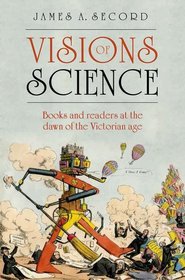
Visions of Science
Books and readers at the dawn of the Victorian age
- Publisher's listprice GBP 23.49
-
10 605 Ft (10 100 Ft + 5% VAT)
The price is estimated because at the time of ordering we do not know what conversion rates will apply to HUF / product currency when the book arrives. In case HUF is weaker, the price increases slightly, in case HUF is stronger, the price goes lower slightly.
- Discount 20% (cc. 2 121 Ft off)
- Discounted price 8 484 Ft (8 080 Ft + 5% VAT)
- Discount is valid until: 30 June 2026
Subcribe now and take benefit of a favourable price.
Subscribe
10 605 Ft

Availability
Estimated delivery time: In stock at the publisher, but not at Prospero's office. Delivery time approx. 3-5 weeks.
Not in stock at Prospero.
Why don't you give exact delivery time?
Delivery time is estimated on our previous experiences. We give estimations only, because we order from outside Hungary, and the delivery time mainly depends on how quickly the publisher supplies the book. Faster or slower deliveries both happen, but we do our best to supply as quickly as possible.
Product details:
- Publisher OUP Oxford
- Date of Publication 27 March 2014
- ISBN 9780199675265
- Binding Hardback
- No. of pages320 pages
- Size 238x162x30 mm
- Weight 624 g
- Language English
- Illustrations One 8pp colour plate section and 21 black and white illustrations 0
Categories
Short description:
Whilst political and social events shook continental Europe, scientific developments were changing the way we understood the world. At the height of this change a series of remarkable books about science were published. In Visions of Science, Jim Secord explores a selection of these titles and how they were received, disseminated, and admired.
MoreLong description:
The early 1830s witnessed an extraordinary transformation in British political, literary, and intellectual life. New scientific disciplines begin to take shape, while new concepts of the natural world were hotly debated. James Secord, Director of the Darwin Correspondence Project, captures this unique moment of change by exploring key books, including Charles Lyell's Principles of Geology, Mary Somerville's Connexion of the Physical Sciences, and Thomas Carlyle's satirical work, Sartor Resartus. Set in the context of electoral reform and debates about the extension of education to meet the demands of the coming age of empire and industry, Secord shows how the books were published, disseminated, admired, attacked and satirized.
It is a useful reminder that science does not always advance in straight lines.
Table of Contents:
Preface
Introduction
Fantastic Voyages: Humphry Davys Consolations in Travel
The Economy of Intelligence: Charles Babbages Reflections on the Decline of Science
The Conduct of Everyday Life: John Herschels Preliminary Discourse on the Study of Natural Philosophy
Mathematics for the Million?: Mary Somervilles On the Connexion of the Physical Sciences
A Philosophy for a New Science: Charles Lyells Principles of Geology
The Problem of Mind: George Combes Constitution of Man
The Torch of Science: Thomas Carlyles Sartor Resartus
Epilogue
Chronology
Further Reading
Abbreviations
Notes
Bibliography of Works after 1900
Index

