

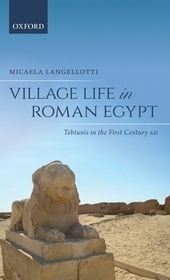
Village Life in Roman Egypt
Tebtunis in the First Century AD
- Publisher's listprice GBP 110.00
-
49 665 Ft (47 300 Ft + 5% VAT)
The price is estimated because at the time of ordering we do not know what conversion rates will apply to HUF / product currency when the book arrives. In case HUF is weaker, the price increases slightly, in case HUF is stronger, the price goes lower slightly.
- Discount 10% (cc. 4 967 Ft off)
- Discounted price 44 699 Ft (42 570 Ft + 5% VAT)
Subcribe now and take benefit of a favourable price.
Subscribe
49 665 Ft

Availability
Estimated delivery time: In stock at the publisher, but not at Prospero's office. Delivery time approx. 3-5 weeks.
Not in stock at Prospero.
Why don't you give exact delivery time?
Delivery time is estimated on our previous experiences. We give estimations only, because we order from outside Hungary, and the delivery time mainly depends on how quickly the publisher supplies the book. Faster or slower deliveries both happen, but we do our best to supply as quickly as possible.
Product details:
- Publisher OUP Oxford
- Date of Publication 4 February 2020
- ISBN 9780198835318
- Binding Hardback
- No. of pages320 pages
- Size 215x145x24 mm
- Weight 522 g
- Language English 0
Categories
Short description:
This book presents the first detailed study of Tebtunis, a village in Egypt within the Roman Empire, in the first century AD. It is founded on the archive material of the local notarial office, covering over two hundred documents which provide a unique insight into various aspects of village life.
MoreLong description:
This book presents the first detailed study of Tebtunis, a village in Egypt within the Roman Empire, in the first century AD. It is founded on the archive material of the local notarial office, or grapheion, which was run by a man named Kronion for most of the mid-first century. The archive, unparalleled in antiquity, includes over two hundred documents written on papyrus which attest a wide range of transactions made by the villagers over defined periods of time, in particular the years AD 42 and 45-7 under the reign of the emperor Claudius. This evidence provides a unique insight into various aspects of village life: the level of participation in the written contractual economy; the socio-economic stratification of the village, including the position of women, slaves, priests, and the role of the elite; the functions of associations; the types and importance of agriculture; and non-agricultural activities.
This multitude of data reveals a highly diversified village economy, a large involvement in written transactions among all the strata of the population, and a rural society living mostly above subsistence level. Tebtunis provides a model of village society that can be used to understand the majority of the population within the Roman Empire who lived outside cities in the Mediterranean, particularly in the other eastern and more Hellenized provinces.
In six clearly organised chapters L. successfully weaves her way through a mass of detailed material, which she regularly subjects to quantitative analysis, so as to present a micro-historical study of first-century AD Tebtunis within its broader historical context ... Clarity of argument throughout is a striking feature of this study.
Table of Contents:
Introduction
The Archive of Kronion
The People of Tebtunis
The Social Stratification of First-Century Tebtunis
Land, Landowners, and Tenants: The Agricultural Economy
The Non-Agricultural Economy
Conclusions

