

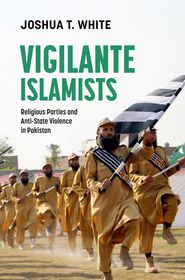
Vigilante Islamists
Religious Parties and Anti-State Violence in Pakistan
- Publisher's listprice GBP 64.00
-
28 896 Ft (27 520 Ft + 5% VAT)
The price is estimated because at the time of ordering we do not know what conversion rates will apply to HUF / product currency when the book arrives. In case HUF is weaker, the price increases slightly, in case HUF is stronger, the price goes lower slightly.
- Discount 10% (cc. 2 890 Ft off)
- Discounted price 26 006 Ft (24 768 Ft + 5% VAT)
Subcribe now and take benefit of a favourable price.
Subscribe
28 896 Ft

Availability
printed on demand
Why don't you give exact delivery time?
Delivery time is estimated on our previous experiences. We give estimations only, because we order from outside Hungary, and the delivery time mainly depends on how quickly the publisher supplies the book. Faster or slower deliveries both happen, but we do our best to supply as quickly as possible.
Product details:
- Publisher OUP USA
- Date of Publication 19 September 2025
- ISBN 9780197814130
- Binding Hardback
- No. of pages312 pages
- Size 19x156x235 mm
- Weight 547 g
- Language English 622
Categories
Short description:
For over three decades the Pakistani state has had to contend with the rise of violent anti-state movements that have sought to overthrow the government for being insufficiently Islamic. This book provides an inside look at how Islamist political parties-which often have sympathies with these radical groups, but also have a stake in the democratic system-make decisions about whether to support or undermine violent movements that are challenging the state. With five studies that span three decades, the book provides a detailed look at some of Pakistan's most interesting and controversial political parties.
MoreLong description:
Vigilante Islamists investigates the role that Pakistan's Islamist political parties have played since the 1990s as both collaborators and competitors with violent anti-state movements. Drawing on dozens of interviews with party insiders, Urdu-language publications, and internal documents, White explains the ways in which these small but influential parties have navigated between their interests in championing an ever-more expansive vision of Islamic law, and continuing their legitimate participation in democratic politics.
The book argues that the decisions of Islamist parties about whether to embrace violent anti-state movements or countenance vigilantism within their own ranks are shaped in part by their religious and ideological traditions, but more so by their own vulnerabilities-both to radical fringe groups, and to Pakistan's own powerful security services. The book's five case studies, spanning three decades, map these vulnerabilities and motivations within the country's leading Islamist parties.
This analysis provides insights into the inner workings of prominent Islamist organizations, and the strategies that they select to endorse, or quietly undermine, anti-state militants. More broadly, the book sheds light on how and when Islamist parties in South Asia, Southeast Asia, and the Middle East might decide to collaborate with radical movements that violently challenge the existing political order.
Table of Contents:
Acknowledgments
A Note on Transliteration
Part 1
''Democratic Islamists'' and the Anti-State Turn
The Islamist Party Landscape
Ideology and Islamist Party Behavior
The Structural Roots of Islamist Party Behavior: Party Organization and Affiliate Relationships
The Structural Roots of Islamist Party Behavior: Relationships with Militants and the State
Part 2
Early Uprisings: TNSM in Malakand
Islamic Governance and the Allure of Vigilantism: The MMA in the Frontier
Capital Crimes: The Red Mosque in Islamabad
Good Taliban, Bad Taliban: Negotiating the TTP's Rise
Barelvi Street Power: The TLP
Conclusion: The Conflicted Islamists
Index

