

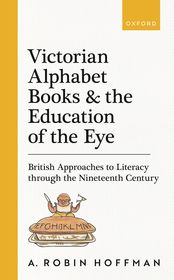
Victorian Alphabet Books and the Education of the Eye
British Approaches to Literacy through the Nineteenth Century
- Publisher's listprice GBP 77.00
-
34 765 Ft (33 110 Ft + 5% VAT)
The price is estimated because at the time of ordering we do not know what conversion rates will apply to HUF / product currency when the book arrives. In case HUF is weaker, the price increases slightly, in case HUF is stronger, the price goes lower slightly.
- Discount 20% (cc. 6 953 Ft off)
- Discounted price 27 812 Ft (26 488 Ft + 5% VAT)
- Discount is valid until: 30 June 2026
Subcribe now and take benefit of a favourable price.
Subscribe
34 765 Ft

Availability
Estimated delivery time: In stock at the publisher, but not at Prospero's office. Delivery time approx. 3-5 weeks.
Not in stock at Prospero.
Why don't you give exact delivery time?
Delivery time is estimated on our previous experiences. We give estimations only, because we order from outside Hungary, and the delivery time mainly depends on how quickly the publisher supplies the book. Faster or slower deliveries both happen, but we do our best to supply as quickly as possible.
Product details:
- Publisher OUP Oxford
- Date of Publication 21 November 2024
- ISBN 9780198938132
- Binding Hardback
- No. of pages256 pages
- Size 224x140x18 mm
- Weight 422 g
- Language English 556
Categories
Short description:
Explores what nineteenth-century alphabet books can tell us about literacy and constructions of childhood in Britain throughout this period. The volume shows how artists and writers including William Thackeray, Edward Lear, and Kate Greenaway participated in ongoing debates about what counted as literacy and how reading should be taught.
MoreLong description:
Victorian Alphabet Books and the Education of the Eye shows how the familiar genre went beyond mere reading instruction to offer nineteenth-century British writers, illustrators, and publishers a site for representing and re-thinking literacy itself. This interdisciplinary study traces how individuals throughout the Victorian era deployed alphabet books to promote visual literacy or oral culture as a vital complement to textual literacy. Their strategies ranged from puns and political allusions to elaborate designs that addressed adult audiences alongside or even instead of children. As the format became more familiar in the first part of Victoria's reign, George Cruikshank, William Makepeace Thackeray, Henry Cole, and Edward Lear were quick to recognize its critical potential.
This history pivots around the mid-1860s and 1870s, when the production of illustrated alphabet books exploded thanks to evolving printing technology and national education reform. Case studies of individual works and makers show how a revolution in picture books reflected and responded to laws assuring children's access to schooling. On the one hand, Socialist artist Walter Crane was able to develop alphabetical illustration from a utilitarian mid-century product into an aesthetically rich, yet accessibly priced "education of the eye." On the other hand, Kate Greenaway, Hablot Knight Browne (Phiz), and their publishers tended to leverage commercialized nostalgia against pedagogy. This survey concludes by showing how market-oriented trends and the development of photographic reproduction toward the end of the century fed into interpretations of the alphabet, including works by Rudyard Kipling and Hilaire Belloc, that reflected growing ambivalence about industrialized print culture.
Table of Contents:
Introduction: The Alphabet and Literacies
Alphabet Books and Satire at the Dawn of Victorian England
Mid-Century Alphabet Books and Waiting for the Revolution
The Perils and Pleasures of Pronunciation and Perspective in Edward Lear's Nonsense Alphabets
Walter Crane, the Alphabet, and the Value of "So-Called Children's Books
Brand-Name Alphabet Books and Reading the Victorian Marketplace
Inevitable Literacy and the Alphabet at the Fin de Siècle
Works Cited

