

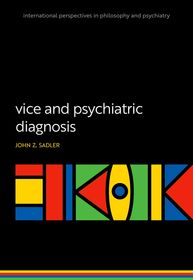
Vice and Psychiatric Diagnosis
Series: International Perspectives in Philosophy and Psychiatry;
- Publisher's listprice GBP 105.00
-
50 163 Ft (47 775 Ft + 5% VAT)
The price is estimated because at the time of ordering we do not know what conversion rates will apply to HUF / product currency when the book arrives. In case HUF is weaker, the price increases slightly, in case HUF is stronger, the price goes lower slightly.
- Discount 10% (cc. 5 016 Ft off)
- Discounted price 45 147 Ft (42 998 Ft + 5% VAT)
Subcribe now and take benefit of a favourable price.
Subscribe
50 163 Ft

Availability
Estimated delivery time: In stock at the publisher, but not at Prospero's office. Delivery time approx. 3-5 weeks.
Not in stock at Prospero.
Why don't you give exact delivery time?
Delivery time is estimated on our previous experiences. We give estimations only, because we order from outside Hungary, and the delivery time mainly depends on how quickly the publisher supplies the book. Faster or slower deliveries both happen, but we do our best to supply as quickly as possible.
Product details:
- Publisher OUP Oxford
- Date of Publication 14 March 2024
- ISBN 9780198876830
- Binding Hardback
- No. of pages622 pages
- Size 254x176x40 mm
- Weight 1240 g
- Language English 495
Categories
Short description:
Vice and Psychiatric Diagnosis outlines the implications of vice concepts being incorporated into psychiatric diagnosis and clinical practice, leading to some of the vexing problems in mental health and social care.
MoreLong description:
Vice and Psychiatric Diagnosis begins with the simple question of why some categories of mental disorder include immoral or criminal conduct as diagnostic features, while most mental disorders in the DSM and ICD do not involve such "vice-laden" concepts. While this initial puzzle seems to concern only the limited domain of psychiatric nosology, Sadler's expansive scholarship reveals that this simple question leads inexorably to complex questions about the role of "madness and morality" in intellectual history, and to today's many conflicts and contradictions in the policy and culture of mental health, criminal justice, and related social welfare efforts.
The book outlines the implications of vice concepts being incorporated into psychiatric diagnosis and clinical practice, leading to some of the vexing problems in mental health and social care. These issues include the fragmentation of care in social welfare efforts involving mentally ill people, criminal offenders, intellectually disabled individuals, and juvenile offenders. The analysis extends to cultural attitudes and policies as well: the insanity defense, managing the mentally ill criminal offender, the value of punishment in criminal justice, and derivative issues such as the ethics of forensic psychiatry, the growing problem of mass shootings, stigma, health literacy, and the difficulties in pursuing rigorous and consistent approaches to psychiatric diagnostic classification.
In the pursuit of untangling these threads of vice and psychiatric diagnosis, Sadler provides a brief history of ideas about madness and morality, beginning in prehistory and extending into the late 20th century. The lessons from this history are applied in subsequent chapters, examining the "vice-mental disorder relationship" from the perspectives of philosophical/conceptual issues, the perspectives of criminal law and the criminal justice system, and the perspectives of public interest and public opinion. The concluding chapters formulate an alternative way of thinking about the vice-mental disorder relationship in clinical practice and public policy, culminating in "Forty Theses" which present the detailed conclusions and social implications for this monumental work.
In the perennial theoretical, clinical, legal, and political discourse between "mad and bad," Sadler has brought his characteristic conceptual rigor and psychiatric acumen to reconceptualizing the relationship between psychiatric diagnosis and behavior that is both wrongful and criminal (vice). In articulating and developing this "vice-mental-disorder-relationship" or VMDR, he has systematically and convincingly created a new paradigm for interrogating historical narratives regarding the interplay of mental illness, criminality, and immorality and generated a compelling framework with theoretical and practical applicability for today and for the future.
Table of Contents:
Preface
Introduction
Vice and the DSMs - the Problem
Conceptual Paradoxes in Vice and Mental Disorder
Vice and Mental Illness - an Ancient-to-Modern Iconography
Building a Moral-Medical Psychiatry
The Legal and Criminal-Justice Context of the VMDR
The Public Interest Context of the VMDR
Deepening the Analysis of the Vice-Mental Disorder Relationship
Forty Theses: Conclusions, Implications, Prescriptions
Bibliography

