

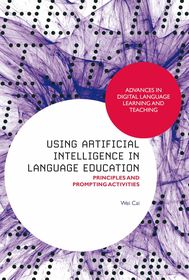
Using Artificial Intelligence in Language Education
Principles and Prompting Activities
Series: Advances in Digital Language Learning and Teaching;
-
GET 18% OFF
- Publisher's listprice GBP 95.00
-
42 892 Ft (40 850 Ft + 5% VAT)
The price is estimated because at the time of ordering we do not know what conversion rates will apply to HUF / product currency when the book arrives. In case HUF is weaker, the price increases slightly, in case HUF is stronger, the price goes lower slightly.
- Discount 18% (cc. 7 720 Ft off)
- Discounted price 35 172 Ft (33 497 Ft + 5% VAT)
- Discount is valid until: 31 October 2026
35 172 Ft

Availability
Not yet published.
Why don't you give exact delivery time?
Delivery time is estimated on our previous experiences. We give estimations only, because we order from outside Hungary, and the delivery time mainly depends on how quickly the publisher supplies the book. Faster or slower deliveries both happen, but we do our best to supply as quickly as possible.
Product details:
- Publisher Bloomsbury Publishing (UK)
- Date of Publication 6 August 2026
- ISBN 9781350457164
- Binding Hardback
- No. of pages296 pages
- Size 234x156 mm
- Language
- Illustrations 10 bw illus 700
Categories
Long description:
This book explores principled approaches to integrating Generative Artificial Intelligence (GenAI) into language learning and teaching.
It examines the features of learner-AI interaction, the affordances of GenAI, and key principles that guide its use in language education. Drawing on second language acquisition theories and teaching methodologies, the book investigates how GenAI can support the development of listening, speaking, reading, and writing, as well as task-based language teaching.
Illustrated through concrete prompting activities, Using Artificial Intelligence in Language Education translates theory and research into practical pedagogy for meaningful AI-mediated language learning. It empowers teachers to use GenAI confidently and to help learners engage in purposeful learning experiences.
Filling a critical gap by offering language learners and teachers principled guidance and practical examples, this is also an indispensable source of ideas for learners and teachers to develop their own applications.
Table of Contents:
Chapter 1: Rethinking language learning in the age of GenAI
Chapter 2: Overview of AI in language learning and teaching
Chapter 3: L2 acquisition theories and GenAI affordances
Chapter 4: Principles of purposeful language learning with GenAI
Chapter 5: Learning listening with GenAI
Chapter 6: Learning speaking with GenAI
Chapter 7: Learning reading with GenAI
Chapter 8: Learning writing with GenAI
Chapter 9: Task-based language teaching with GenAI
Chapter 10: Looking ahead: Rethinking language education in the age of GenAI
References
Index

