

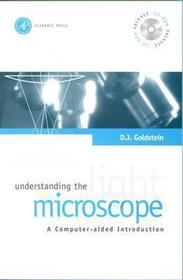
Understanding the Light Microscope
A Computer-Aided Introduction
- Publisher's listprice EUR 82.95
-
32 400 Ft (30 857 Ft + 5% VAT)
The price is estimated because at the time of ordering we do not know what conversion rates will apply to HUF / product currency when the book arrives. In case HUF is weaker, the price increases slightly, in case HUF is stronger, the price goes lower slightly.
- Discount 10% (cc. 3 240 Ft off)
- Discounted price 29 160 Ft (27 771 Ft + 5% VAT)
Subcribe now and take benefit of a favourable price.
Subscribe
32 400 Ft

Availability
cancelled
Why don't you give exact delivery time?
Delivery time is estimated on our previous experiences. We give estimations only, because we order from outside Hungary, and the delivery time mainly depends on how quickly the publisher supplies the book. Faster or slower deliveries both happen, but we do our best to supply as quickly as possible.
Product details:
- Publisher Elsevier Science
- Date of Publication 26 August 1999
- ISBN 9780122886607
- Binding Paperback
- No. of pages160 pages
- Size 229x152 mm
- Weight 340 g
- Language English 0
Categories
Long description:
"Understanding the Light Microscope consists of four original computer programs with an explanatory book. Author Dan Goldstein says using the programs can teach aspects of microscopy and diffraction often missed from formal courses, adding, ""... what one non-mathematician has created should not be beyond the understanding of others!"" The book aims to provide understanding at a level deeper than customary in existing texts and in a form accessible to microscope users, particularly biologists. It covers simple ray optics, the aberrations of ""real"" (thick) lenses, polarized light, and the influence of diffraction on imaging. The book can be read alone, but appreciation of its contents is greatly enhanced when used in conjunction with the programs.D J Goldstein was a Nuffield Dominion Travelling Fellow at Oxford University and a visiting Professor in Pittsburgh. He taught at the Universities of the Witwatersrand (Johannesburg, South Africa) and Sheffield (UK) while publishing research in embryology, histology, immunology, histochemistry and microscopy. Since retiring in 1989 as Reader in Anatomy at Sheffield University, he has been an independent research worker in biomedical science."
MoreTable of Contents:
Diagrams in the Text. Preface. Simple Ray Optics (The Kohler Program). Lenses and Lens Aberrations (The Snellius Program). Elementary Diffraction Theory (Mainly Due to Abbe). Extension of the Abbe Theory to Transparent Objects (Zernike's Phase Contrast). Function of the Microscope Condenser--Partially Coherent Illumination. Interference Contrast. Dark-Field and Related Techniques. Gegenfeld.'Modulation Contrast'. Apodization. Fluorescence. Confocal Scanning. Microdensitometry. Polarized Light (The Nicol Program). How the Zernike Program Works. How to Use the Zernike Program. Some Suggested Exercises Using the Zernike Program. Bibliography. Index.
More
