

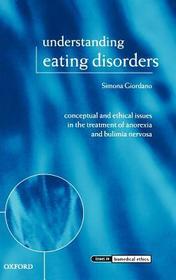
Understanding Eating Disorders
Conceptual and Ethical Issues in the Treatment of Anorexia and Bulimia Nervosa
Series: Issues in Biomedical Ethics;
- Publisher's listprice GBP 127.50
-
57 566 Ft (54 825 Ft + 5% VAT)
The price is estimated because at the time of ordering we do not know what conversion rates will apply to HUF / product currency when the book arrives. In case HUF is weaker, the price increases slightly, in case HUF is stronger, the price goes lower slightly.
- Discount 10% (cc. 5 757 Ft off)
- Discounted price 51 810 Ft (49 343 Ft + 5% VAT)
Subcribe now and take benefit of a favourable price.
Subscribe
57 566 Ft

Availability
printed on demand
Why don't you give exact delivery time?
Delivery time is estimated on our previous experiences. We give estimations only, because we order from outside Hungary, and the delivery time mainly depends on how quickly the publisher supplies the book. Faster or slower deliveries both happen, but we do our best to supply as quickly as possible.
Product details:
- Publisher OUP Oxford
- Date of Publication 25 August 2005
- ISBN 9780199269747
- Binding Hardback
- No. of pages316 pages
- Size 241x163x23 mm
- Weight 634 g
- Language English
- Illustrations 1 black and white illustration 0
Categories
Short description:
Simona Giordano presents the first full philosophical study of ethical issues in the treatment of anorexia and bulimia nervosa. Beginning with a comprehensive analysis of these conditions and an exploration of their complex causes, she then proceeds to address legal and ethical dilemmas such as a patient's refusal of life-saving treatment. Illustrated with many case-studies, Understanding Eating Disorders is an essential tool for anyone working with sufferers of these much misunderstood conditions, and for all those ethicists, lawyers, and medical practitioners engaged with the widely relevant issues they raise.
MoreLong description:
Simona Giordano presents the first full philosophical study of ethical issues in the treatment of anorexia and bulimia nervosa. Beginning with a comprehensive analysis of these conditions and an exploration of their complex causes, she then proceeds to address legal and ethical dilemmas such as a patient's refusal of life-saving treatment. Illustrated with many case-studies, Understanding Eating Disorders is an essential tool for anyone working with sufferers of these much misunderstood conditions, and for all those ethicists, lawyers, and medical practitioners engaged with the widely relevant issues they raise.
MoreTable of Contents:
Part I: Clinical Understanding of Eating Disorders and of the Ethical Issues Involved
Eating Disorders: Anorexia and Bulimia Nervosa
Paternalism vs Respect for Autonomy: the Case of the Eating Disordered Person
Is Pathological Behaviour Caused by Mental Illness?
Scientific Understanding of Eating Disorders
Part II: Eating Disorders and the Value of Lightness
Lightness and Eating Disorders
The Value of Lightness
Part III: The Family and Society of the Person with Eating Disorders
The Role of Expectations in the Genesis of Eating Disorders
The Society of the Person with Eating Disorders
Victims or Persecutors? The Moral Logic at the Heart of Eating Disorders
Familial and Social Causes of Eating Disorders: A Critique of the Systemic and Sociological Approaches to Eating Disorders
Part IV: Legal Issues, Autonomy, and End of Life Decisions
Eating or Treating? Legal and Ethical Issues Surrounding Eating Disorders
Autonomy and Control in Eating Disorders
Anorexia Nervosa and Refusal of Life-Saving Interventions
Conclusion: The Need for Change

