

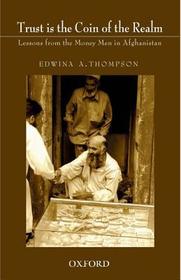
Trust is the Coin of the Realm
Lessons from the Money Men in Afghanistan
- Publisher's listprice GBP 17.99
-
8 122 Ft (7 735 Ft + 5% VAT)
The price is estimated because at the time of ordering we do not know what conversion rates will apply to HUF / product currency when the book arrives. In case HUF is weaker, the price increases slightly, in case HUF is stronger, the price goes lower slightly.
- Discount 10% (cc. 812 Ft off)
- Discounted price 7 310 Ft (6 962 Ft + 5% VAT)
Subcribe now and take benefit of a favourable price.
Subscribe
8 122 Ft

Availability
Uncertain availability. Please turn to our customer service.
Why don't you give exact delivery time?
Delivery time is estimated on our previous experiences. We give estimations only, because we order from outside Hungary, and the delivery time mainly depends on how quickly the publisher supplies the book. Faster or slower deliveries both happen, but we do our best to supply as quickly as possible.
Product details:
- Publisher OUP Pakistan
- Date of Publication 25 August 2011
- ISBN 9780199062980
- Binding Paperback
- No. of pages350 pages
- Size 228x154x21 mm
- Weight 518 g
- Language English 0
Categories
Short description:
This book offers original insights into why current efforts to build a durable peace are failing in Afghanistan and border areas of Pakistan. Competition for trust emerges at the centre of the challenge, as the external reform agenda is contrasted with the indigenous money-dealing business. The modest 'money-men' of the local bazaars persist against all odds through war, international interference and state collapse, offering a powerful lesson to those seeking a
lasting solution to the problems of the region.
Long description:
Following a new US administration entering office, and revision of strategies for international support to Afghanistan, this book fills an urgent gap in the debate on how to make a 'bottom-up' approach to state-building work. Academic, press and policy accounts suggest the current 'top-down' paradigm is inappropriate to the task; none, however, appears to offer the kind of rigorous insights necessary to understand why.
Based on extensive field and archival research into the workings of 'hawala' - an ancient financial system operating throughout the Muslim world which is accused of bankrolling the bulk of today's terrorist operations, but is central to development in fragile states - this book shines a rare light on local-level institutions in Afghanistan and tribally controlled areas of neighbouring Pakistan.
Important dynamics emerge around the legitimacy of externally-imposed change in complex humanitarian and stabilisation environments; the bargain of foreign aid and financial regulation; and the challenge of how to reconcile broad models of state-building with specific and unique contexts. Parties with the strongest hand are proven to be those typically considered to lie at the margins: they are most able to accrue legitimacy and, by association, the trust of the local population.
The book indicates that the future reconstruction of Afghanistan hinges on whether the international community can engage genuinely with indigenous socio-economic networks like those of the 'money-men', for it is trust that emerges ultimately as the 'coin of the realm', not only in the money bazaar, but also against the backdrop of counter-insurgency and state-building efforts within the region.
Table of Contents:
METHOD & THEORY
Introduction
Importance of the study
Definition of key terms
Scope and method
Challenges and limitations
Legitimacy and the State-building Project
The problem
The popular response
The way forward
Implications
LEGACIES
Islam, Terrorism and the Origins of Hawala
Conventional wisdom
Etymology of hawala
World commerce
Role of Islam
Hawala and the Politics of Survival
Empire and state regulation
The bazaar
The Indian trade diaspora and 'family firm'
Conventional wisdom unraveled
LINKAGES
Ritual and Rationality
War and migration
Ethnicity
Stereotypes and social organisation
Rationality
Conclusion
Globalisation and the Money Dealer
Global connections
Global financial systems
Black holes and the borderless world
LEGITIMACY
Informal Economy Revisited
Opium harvests: contemporary linkages with the trade
Black money: the money dealer's perspective
Effects of war
Conclusion
Symbols and Substance of Liberal Reform
What they want: transformation
How they engage: the bargain
Symbolic reconstruction and regulatory ritualism
Conclusion
Concluding Remarks
Bibliography
Appendices
Index

