

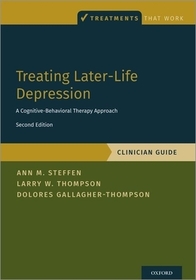
Treating Later-Life Depression
A Cognitive-Behavioral Therapy Approach, Clinician Guide
Series: Treatments That Work;
- Publisher's listprice GBP 57.00
-
25 735 Ft (24 510 Ft + 5% VAT)
The price is estimated because at the time of ordering we do not know what conversion rates will apply to HUF / product currency when the book arrives. In case HUF is weaker, the price increases slightly, in case HUF is stronger, the price goes lower slightly.
- Discount 20% (cc. 5 147 Ft off)
- Discounted price 20 588 Ft (19 608 Ft + 5% VAT)
- Discount is valid until: 30 June 2026
Subcribe now and take benefit of a favourable price.
Subscribe
25 735 Ft

Availability
Estimated delivery time: In stock at the publisher, but not at Prospero's office. Delivery time approx. 3-5 weeks.
Not in stock at Prospero.
Why don't you give exact delivery time?
Delivery time is estimated on our previous experiences. We give estimations only, because we order from outside Hungary, and the delivery time mainly depends on how quickly the publisher supplies the book. Faster or slower deliveries both happen, but we do our best to supply as quickly as possible.
Product details:
- Edition number 2
- Publisher OUP USA
- Date of Publication 6 January 2022
- ISBN 9780190068431
- Binding Paperback
- No. of pages392 pages
- Size 180x254x25 mm
- Weight 703 g
- Language English 168
Categories
Short description:
Treating Later-Life Depression: Clinician Guide outlines culturally responsive practices that target the contexts and drivers/antecedents of depression in middle-aged and older adults. Clinicians can choose research-supported modules from the accompanying Workbook that fit the needs of their clients (i.e. chronic pain, sleep problems, anxiety, experiences of loss).
MoreLong description:
As demographic trends shift toward an aging population, there is a growing need for improved mental health treatment for older adults. With depression as the leading mental health concern in later life, one of the greatest challenges for treatment providers is the wide variability of life circumstances that accompany depressive symptoms for clients across outpatient mental health, integrated primary care, and inpatient psychiatric settings.
Treating Later-Life Depression: Clinician Guide outlines culturally responsive practices that target the contexts and drivers/antecedents of depression in middle-aged and older adults. Clinicians can choose research-supported modules from the accompanying Workbook that fit the needs of their clients (i.e. chronic pain, sleep problems, anxiety, experiences of loss). This practical guide reflects continuing international scientific and clinical advances in applying CBT to age-related problems using individual and group formats, with clinician-tested recommendations for telehealth practice. With the flexible clinical tools provided in this guide, practitioners can personalize the application of change strategies, including behavioral activation, relaxation training, self-compassion, cognitive reappraisal, and communication skills training among others. Case examples are also provided from a range of disciplines (e.g., clinical psychology, psychiatry, social work, counseling, marriage and family therapy, nursing, occupational therapy and recreational specialists) to illustrate application in busy clinical practices. The guide closes with aging-friendly assessment tools and other resources to support ongoing professional development.
Treating Later-Life Depression, Clinician Guide is an indispensable resource for all behavioral health providers who wish to help diverse aging clients thrive effectively and efficiently in a daily life that is true to their values and personal strengths.
If you work with mid-life and/or late-life adults or multi-generational families in any setting, run, don't walk to acquire and read these two newly revised books. They are crucial, even critical, to your understanding of mid and later life depression and working with clients to modify and alleviate their devastating symptoms.
Table of Contents:
Part I: Introductory Information for Clinicians
Chapter 1: How to Use This Treatment Approach
Chapter 2: Depression and Age-Related Issues
Chapter 3: Assessment with Aging Individuals
Chapter 4: Cognitive Behavioral Therapies 101
Chapter 5: Psychotherapy Modifications with Aging Clients
Part II: Core Modules (For Most Clients)
Chapter 6 Module 1: Skills for Getting Started: Planning Your Treatment
Chapter 7 Module 2: Skills for Feeling: Recognizing and Managing Strong Emotions
Chapter 8 Module 3: Skills for Doing: Values-Based Living and Solving Problems
Chapter 9 Module 4: Skills for Thinking: Self-Compassion and Helpful Thoughts
Chapter 10 Module 11: Skills for Wrapping Up: Finishing Treatment
Part III: Personalized Modules (For Some Clients)
Chapter 11 Module 5: Skills for Brain Health: Healthy Cognitive Aging
Chapter 12 Module 6: Skills for Managing Chronic Pain: Improving Daily Life
Chapter 13 Module 7: Skills for Healthy Sleep: Resting Better and Longer
Chapter 14 Module 8: Skills for Caregiving: Reducing Stress While Helping Others
Chapter 15 Module 9: Skills for Living with Loss: Bereavement and Grief
Chapter 16 Module 10: Skills for Relating: Getting Along and Communicating Your Needs
Afterword: Professional Development
Appendix A: Professional Development Resources
Appendix B: Recommendations for Group Treatments
Appendix C: California Older Person's Positive Experiences Schedule-Revised (COPPES-R)
Appendix D: Clinical Tools and Measures

