

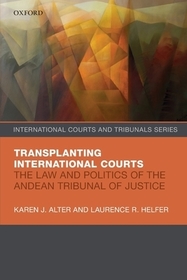
Transplanting International Courts
The Law and Politics of the Andean Tribunal of Justice
Series: International Courts and Tribunals Series;
- Publisher's listprice GBP 32.99
-
14 894 Ft (14 185 Ft + 5% VAT)
The price is estimated because at the time of ordering we do not know what conversion rates will apply to HUF / product currency when the book arrives. In case HUF is weaker, the price increases slightly, in case HUF is stronger, the price goes lower slightly.
- Discount 10% (cc. 1 489 Ft off)
- Discounted price 13 405 Ft (12 767 Ft + 5% VAT)
Subcribe now and take benefit of a favourable price.
Subscribe
14 894 Ft

Availability
printed on demand
Why don't you give exact delivery time?
Delivery time is estimated on our previous experiences. We give estimations only, because we order from outside Hungary, and the delivery time mainly depends on how quickly the publisher supplies the book. Faster or slower deliveries both happen, but we do our best to supply as quickly as possible.
Product details:
- Publisher OUP Oxford
- Date of Publication 8 January 2019
- ISBN 9780198838807
- Binding Paperback
- No. of pages336 pages
- Size 234x161x19 mm
- Weight 510 g
- Language English 0
Categories
Short description:
Transplanting International Courts provides a systematic investigation of the most active and successful transplant of the European Court of Justice. Alter and Helfer show how the Andean experience offers timely and important lessons for Europe's international courts, as well as those in other developing regions.
MoreLong description:
Transplanting International Courts provides a deep, systematic investigation of the most active and successful transplant of the European Court of Justice. The Andean Tribunal is effective by any plausible definition of the term, but only in the domain of intellectual property law. Alter and Helfer explain how the Andean Tribunal established its legal authority within and beyond this intellectual property island, and how Andean judges have navigated moments of both transnational political consensus and political contestation over the goals and objectives of regional economic integration. By letting member states set the pace and scope of Andean integration, by condemning unequivocal violations of Andean rules, and by allowing for the coexistence of national legislation and supranational authority, the Tribunal has retained its fidelity to Andean law while building relationships with nationally-based administrative agencies, lawyers, and judges. Yet the Tribunal's circumspect and formalist approach means that, unlike in Europe, Community law is not an engine of integration. The Tribunal's strategy has also limited its influence within the Andean legal system.
Transplanting International Courts also revists the authors' path-breaking scholarship on the effectiveness of international adjudication. Alter and Helfer argue that the European Court of Justice benefitted in underappreciated ways from the support of jurist advocacy movements that are absent or poorly organized in the Andes and elsewhere in the world. The Andean Tribunal's longevity despite these and other challenges offers guidance for international courts in other developing country contexts. Moreover, given that the Andean Community has weathered member state withdrawals and threats of exit, major economic and political crises, and the retrenchment of core policies such as the common external tariff, the Andean experience offers timely and important lessons for Europe's international courts.
Whatever your interests in this field, whatever transnational system you may be researching or teaching, the rich insights of this book on how to think of such will upgrade your own analytical (and normative) toolkit. As a side benefit, it is very well written - a good read.
Table of Contents:
Part I: Supranational Legal Transplants
Lessons from the Andean Tribunal of Justice: Thirty Years as a Legal Transplant
Transplanting the European Court of Justice to the Andes
Part II: Law and Politics in the Andean Tribunal of Justice
The Andean Tribunal of Justice and its Interlocutors: Understanding Litigation Patterns in the Andean Community
The Divergent Jurisprudential Paths of the Andean Tribunal of Justice and the European Court of Justice
Islands of Effective International Adjudication: Constructing an Intellectual Property Rule of Law in the Andean Community
The Judicialization of Andean Politics: Cigarettes, Alcohol, and Economic Hard Times
The Authority of the Andean Tribunal of Justice in a Time of Regional Political Crisis
Part III: Reconsidering International Adjudication in Europe in Light of the Andean Experience
Nature or Nurture? Judicial Lawmaking in the European Court of Justice and the Andean Tribunal of Justice
Jurist Advocacy Movements in Europe and the Andes
Reconsidering What Makes International Courts Effective

