

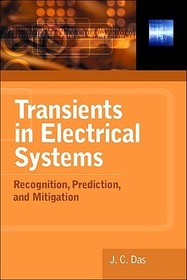
Transients in Electrical Systems: Analysis, Recognition, and Mitigation
Series: ELECTRONICS;
- Publisher's listprice GBP 171.99
-
82 168 Ft (78 255 Ft + 5% VAT)
The price is estimated because at the time of ordering we do not know what conversion rates will apply to HUF / product currency when the book arrives. In case HUF is weaker, the price increases slightly, in case HUF is stronger, the price goes lower slightly.
- Discount 10% (cc. 8 217 Ft off)
- Discounted price 73 951 Ft (70 430 Ft + 5% VAT)
Subcribe now and take benefit of a favourable price.
Subscribe
82 168 Ft

Availability
Estimated delivery time: In stock at the publisher, but not at Prospero's office. Delivery time approx. 3-5 weeks.
Not in stock at Prospero.
Why don't you give exact delivery time?
Delivery time is estimated on our previous experiences. We give estimations only, because we order from outside Hungary, and the delivery time mainly depends on how quickly the publisher supplies the book. Faster or slower deliveries both happen, but we do our best to supply as quickly as possible.
Product details:
- Publisher McGraw-Hill Education
- Date of Publication 16 July 2010
- ISBN 9780071622486
- Binding Hardback
- No. of pages736 pages
- Size 284x223x31 mm
- Weight 1680 g
- Language English 0
Categories
Short description:
Proven techniques for detecting and eliminating transients in electrical systems
MoreLong description:
Publisher's Note: Products purchased from Third Party sellers are not guaranteed by the publisher for quality, authenticity, or access to any online entitlements included with the product.
Detect and Mitigate Transients in Electrical Systems
This practical guide explains how to identify the origin of disturbances in electrical systems and analyze them for effective mitigation and control. Transients in Electrical Systems considers all transient frequencies, ranging from 0.1 Hz to 50 MHz, and discusses transmission line and cable modeling as well as frequency dependent behavior. Results of EMTP simulations, solved examples, and detailed equations are included in this comprehensive resource.
Transients in Electrical Systems covers:
- Transients in lumped circuits
- Control systems
- Lightning strokes, shielding, and backflashovers
- Transients of shunt capacitor banks
- Switching transients and temporary overvoltages
- Current interruption in AC circuits
- Symmetrical and unsymmetrical short-circuit currents
- Transient behavior of synchronous generators, induction and synchronous motors, and transformers
- Power electronic equipment
- Flicker, bus, transfer, and torsional vibrations
- Insulation coordination
- Gas insulated substations
- Transients in low-voltage and grounding systems
- Surge arresters
- DC systems, short-circuits, distributions, and HVDC
- Smart grids and wind power generation
Publisher's Note: Products purchased from Third Party sellers are not guaranteed by the publisher for quality, authenticity, or access to any online entitlements included with the product.
Detect and Mitigate Transients in Electrical Systems
This practical guide explains how to identify the origin of disturbances in electrical systems and analyze them for effective mitigation and control. Transients in Electrical Systems considers all transient frequencies, ranging from 0.1 Hz to 50 MHz, and discusses transmission line and cable modeling as well as frequency dependent behavior. Results of EMTP simulations, solved examples, and detailed equations are included in this comprehensive resource.
Transients in Electrical Systems covers:
- Transients in lumped circuits
- Control systems
- Lightning strokes, shielding, and backflashovers
- Transients of shunt capacitor banks
- Switching transients and temporary overvoltages
- Current interruption in AC circuits
- Symmetrical and unsymmetrical short-circuit currents
- Transient behavior of synchronous generators, induction and synchronous motors, and transformers
- Power electronic equipment
- Flicker, bus, transfer, and torsional vibrations
- Insulation coordination
- Gas insulated substations
- Transients in low-voltage and grounding systems
- Surge arresters
- DC systems, short-circuits, distributions, and HVDC
- Smart grids and wind power generation
Table of Contents:
Chapter 1. Introduction to Transients; Chapter 2. Transients in Lumped Circuits; Chapter 3. Control Systems; Chapter 4. Modeling of Transmission Lines and Cables for Transient Studies; Chapter 5. Lighting Strokes, Shielding, and Backflashovers; Chapter 6. Transients of Shunt Capacitor Banks; Chapter 7. Switching Transients and Temporary Overvoltages; Chapter 8. Current Interruption in AC Circuits; Chapter 9. Symmetrical and Unsymmetrical Short-Circuit Currents; Chapter 10. Transient Behavior of Synchronous Generators; Chapter 11. Transient behavior of Induction and Synchronous Motors; Chapter 12. Power System Stability; Chapter 13. Excitation Systems and Power System Stabilizers; Chapter 14. Transient Behavior of Transformers; Chapter 15. Power Electric Equipment and FACTS; Chapter 16. Flicker, Bus Transfer, Torsional Dynamics, and Other Transients; Chapter 17. Insulation Coordination; Chapter 18. Gas-Insulated Substations--Very Fast Transients; Chapter 19. Transients and Surge Protection in Low-Voltage Systems; Chapter 20. Surge Arresters; Chapter 21. Transients in Grounding Systems; Chapter 22. Lightning Protection of Structures; Chapter 23. DC Systems, Short Circuits, Distributions, and HVDC; Chapter 24. Smart Grids and Wind Power Generation; Appendix A. Differential Equations; Appendix B. Laplace Transform; Appendix C. z- Transform; Appendix D. Sequence Impedances of Transmission Lines and Cables; Appendix E. Energy Functions and Stability; Appendix F. Statistics and Probability; Appendix G. Numerical Techniques; Index
More
