

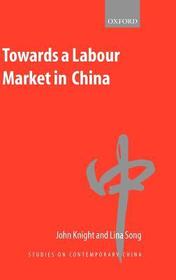
Towards a Labour Market in China
Series: Studies on Contemporary China;
- Publisher's listprice GBP 71.00
-
32 056 Ft (30 530 Ft + 5% VAT)
The price is estimated because at the time of ordering we do not know what conversion rates will apply to HUF / product currency when the book arrives. In case HUF is weaker, the price increases slightly, in case HUF is stronger, the price goes lower slightly.
- Discount 10% (cc. 3 206 Ft off)
- Discounted price 28 851 Ft (27 477 Ft + 5% VAT)
Subcribe now and take benefit of a favourable price.
Subscribe
32 056 Ft

Availability
printed on demand
Why don't you give exact delivery time?
Delivery time is estimated on our previous experiences. We give estimations only, because we order from outside Hungary, and the delivery time mainly depends on how quickly the publisher supplies the book. Faster or slower deliveries both happen, but we do our best to supply as quickly as possible.
Product details:
- Publisher OUP Oxford
- Date of Publication 24 March 2005
- ISBN 9780199245277
- Binding Hardback
- No. of pages280 pages
- Size 242x162x21 mm
- Weight 572 g
- Language English
- Illustrations tables 0
Categories
Short description:
From an administered labour system under central planning, the Chinese economy has moved towards a labour market. This book reviews the progress that has been made over two decades of urban economic reform. It analyses the underlying political economy that has both induced and impeded reform, and examines the economic changes that have unleashed market forces. Based on frontier research using specially designed and collected survey data, the book documents the rising wage inequality, the greater rewards for skills, the growing wage segmentation based on labour immobility and profit-sharing, the emergence of serious urban unemployment, and the competition from the rising tide of rural migrants. China does not yet have a functioning labour market: the book concludes by examining the prospects for its creation.
MoreLong description:
Combining remarkable economic transition and dynamic growth, China may well have the most fascinating economy in the world. Over the period of economic reform China has moved from an administered labour system towards the creation of a labour market. The scale of this transformation, involving new economic incentives, vast labour migration, draconian retrenchment of state workers, and sharply rising wage inequality, is unprecedented in world history.
The authors draw on more than a decade of their research to document and analyse this process. The book uses the rigorous analysis and empirical methodology of modern economics. Much of the evidence used is survey-based but a systematic approach is adopted: economic and sociological theory, institutional analysis and political economy are also used to explain the causes, pressures, obstacles and consequences of the move towards a labour market. It is argued that much progress has been made towards the creation of a labour market but that the process is far from complete. This is reflected in the growing importance of productivity to wages, on the one hand, and the growing wage segmentation across regions and firms, on the other. The underlying policy issue is the tension and trade-off between efficiency and equity objectives, stressed throughout the book.
Because the subject is of such importance and general interest, the book is written for development economists, labour economists, and transition economists as well as for China specialists.
Based on an extensive and original survey work, this book constitutes an enlightening and comprehensive description of the evolution and the current state of the Chinese labour market, in urban as well as rural areas, on the side of individuals, households and firms...This book is of primary importance in the light of China's current growth and of the international concern about its impact on the world's economy, and because of the number of people involved.
Table of Contents:
Introduction
Setting the Stage
Labour Policy and Progress
The Urban Labour Market
Increasing Wage Inequality
The Spatial Behaviour of Wages
Rural Migrants in Urban Enterprises
Redundancies, Unemployment and Migration
Immobility and Segmentation of Labour
The Rural Labour Market
Rural Labour Allocation
The Imperfect Labour Market
Conclusion

