

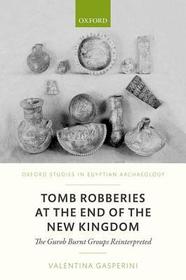
Tomb Robberies at the End of the New Kingdom
The Gurob Burnt Groups Reinterpreted
Series: Oxford Studies in Egyptian Archaeology;
- Publisher's listprice GBP 122.50
-
55 308 Ft (52 675 Ft + 5% VAT)
The price is estimated because at the time of ordering we do not know what conversion rates will apply to HUF / product currency when the book arrives. In case HUF is weaker, the price increases slightly, in case HUF is stronger, the price goes lower slightly.
- Discount 10% (cc. 5 530 Ft off)
- Discounted price 49 778 Ft (47 408 Ft + 5% VAT)
Subcribe now and take benefit of a favourable price.
Subscribe
55 308 Ft

Availability
printed on demand
Why don't you give exact delivery time?
Delivery time is estimated on our previous experiences. We give estimations only, because we order from outside Hungary, and the delivery time mainly depends on how quickly the publisher supplies the book. Faster or slower deliveries both happen, but we do our best to supply as quickly as possible.
Product details:
- Publisher OUP Oxford
- Date of Publication 12 July 2018
- ISBN 9780198818786
- Binding Hardback
- No. of pages338 pages
- Size 238x163x24 mm
- Weight 750 g
- Language English 0
Categories
Short description:
This book focuses on a series of archaeological assemblages excavated at the end of the 19th century at the archaeological site of Gurob (Fayum/Egypt). More than 100 years after their discovery, all the materials are presented together for the first time and are fully studied and analysed according to a modern archaeological approach.
MoreLong description:
At the end of the 19th century W.M.F. Petrie excavated a series of assemblages at the New Kingdom Fayum site of Gurob. These deposits, known in the Egyptological literature as 'Burnt Groups', were composed by several and varied materials (mainly Egyptian and imported pottery, faience, stone and wood vessels, jewellery), all deliberately burnt and buried in the harem palace area of the settlement. Since their discovery these deposits have been considered peculiar and unparalleled. Many scholars were challenged by them and different theories were formulated to explain these enigmatic 'Burnt Groups'.
The materials excavated from these assemblages are now curated at several Museum collections across England: Ashmolean Museum, British Museum, Manchester Museum, and Petrie Museum. For the first time since their discovery, this book presents these materials all together. Gasperini has studied and visually analysed all the items. This research sheds new light on the chronology of deposition of these assemblages, additionally a new interpretation of their nature, primary deposition, and function is presented in the conclusive chapter. The current study also gives new information on the abandonment of the Gurob settlement and adds new social perspective on a crucial phase of the ancient Egyptian history: the transition between the late New Kingdom and the early Third Intermediate Period. Beside the traditional archaeological sources, literary evidence ('The Great Tomb Robberies Papyri') is taken into account to formulate a new theory on the deposition of these assemblages.
Highly Recommended.
Table of Contents:
Introduction
The Burnt Group of Amenhotep III
The Burnt Group of Tutankhamon
The First Burnt Group of Ramesses II
The Second Burnt Group of Ramesses II
The Burnt Group of Sety II
Burnt Group '3'
Burnt Group '7'
Burnt Group 'X'
Conclusions

