

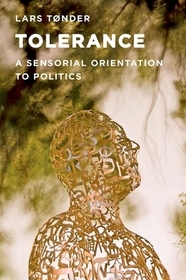
Tolerance
A Sensorial Orientation to Politics
- Publisher's listprice GBP 30.49
-
13 766 Ft (13 110 Ft + 5% VAT)
The price is estimated because at the time of ordering we do not know what conversion rates will apply to HUF / product currency when the book arrives. In case HUF is weaker, the price increases slightly, in case HUF is stronger, the price goes lower slightly.
- Discount 10% (cc. 1 377 Ft off)
- Discounted price 12 389 Ft (11 799 Ft + 5% VAT)
Subcribe now and take benefit of a favourable price.
Subscribe
13 766 Ft

Availability
printed on demand
Why don't you give exact delivery time?
Delivery time is estimated on our previous experiences. We give estimations only, because we order from outside Hungary, and the delivery time mainly depends on how quickly the publisher supplies the book. Faster or slower deliveries both happen, but we do our best to supply as quickly as possible.
Product details:
- Publisher OUP USA
- Date of Publication 17 October 2013
- ISBN 9780199315819
- Binding Paperback
- No. of pages208 pages
- Size 155x231x17 mm
- Weight 272 g
- Language English 0
Categories
Short description:
The main task of Tolerance is to reorient discussions in democratic theory so as better to theorize how tolerance can operate as an active force in the context of deep pluralism. The objective is to develop a theory of active tolerance attentive to the many different ways in which societies can become tolerant.
MoreLong description:
The main task of Tolerance is to reorient discussions in democratic theory so as better to theorize how tolerance can operate as an active force in the context of deep pluralism. The objective is to develop a theory of active tolerance attentive to the many different ways in which societies can become tolerant, and to discuss what might get lost, conceptually as well as politically, if we don't pay attention to how active tolerance subsists within other practices of tolerance. Tolerance exceeds existing accounts, I argue, not because it cannot be domesticated for the purposes of either restraint or benevolence, but because this domestication does not preclude the possibility of another, more active tolerance.
Tolerance develops this argument by mobilizing what I call a "sensorial orientation to politics." While a sensorial orientation does not refute the role of reason in democratic politics, it differs from its intellectualist counterpart by arguing that practices of reason-giving include ways of sensing the world, insisting that reason is always-already sensorial. A sensorial orientation, in other words, focuses on the embodied conditions of reasoning, which it takes to be neither completely synergistic nor immediately present, but reliant on representations, images, and memories, which situate sensory input within historically defined regimes of discourse and sensation, and which assume that sentient beings experience the world through both thought and action, mind and body.
Theorists discussed in the book include Seneca, Spinoza, Nietzsche, Marcuse, and Merleau-Ponty, together with Descartes, Locke, Kant, Mill, Rawls, Forst, Scanlon, Taylor, Brown, and Connolly. Tolerance draws on a critical consideration of these thinkers in order to shed new light on the role of tolerance in both contemporary democratic theory and contemporary public discourse. The aim is to show how tolerance once again can become a practice of empowerment and pluralization.
Lars T?nder's Tolerance offers a highly original and sharply presented analysis of one of the most important concepts in democratic theory. This book is very timely in terms of its pertinence to many of today's crises and catastrophes.
Table of Contents:
Acknowledgements
Introduction: Tolerance in Question
Chapter 1: Impossible Tolerance
Chapter 2: Remembering Tolerance
Chapter 3: Affirming Tolerance
Chapter 4: Perceiving Tolerance
Conclusion: Diogenes and Us
Notes
Bibliography
Index

