

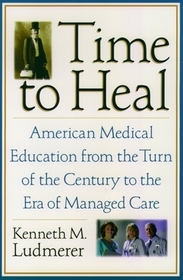
Time to Heal
American medical education from the turn of the century to the era of managed care
- Publisher's listprice GBP 37.99
-
17 152 Ft (16 335 Ft + 5% VAT)
The price is estimated because at the time of ordering we do not know what conversion rates will apply to HUF / product currency when the book arrives. In case HUF is weaker, the price increases slightly, in case HUF is stronger, the price goes lower slightly.
- Discount 10% (cc. 1 715 Ft off)
- Discounted price 15 437 Ft (14 702 Ft + 5% VAT)
Subcribe now and take benefit of a favourable price.
Subscribe
17 152 Ft

Availability
printed on demand
Why don't you give exact delivery time?
Delivery time is estimated on our previous experiences. We give estimations only, because we order from outside Hungary, and the delivery time mainly depends on how quickly the publisher supplies the book. Faster or slower deliveries both happen, but we do our best to supply as quickly as possible.
Product details:
- Edition number New ed
- Publisher OUP USA
- Date of Publication 10 February 2005
- ISBN 9780195181364
- Binding Paperback
- No. of pages544 pages
- Size 232x160x36 mm
- Weight 739 g
- Language English
- Illustrations numerous tables and line drawings 0
Categories
Short description:
Kenneth Ludmerer describes the evolution of American medical education from 1910, when a controversial report on medical diploma mills spurred the reform and expansion of medical schools, to the current era of managed care, when commercial interests once more have come to the fore, compromising the training of the nation's future doctors. Ludmerer portrays the experience of learning medicine from the perspective of students, faculty, administrators, and patients, and he describes the effects of external social factors on academic centers as well. Most notably, the book explores the very real threats to medical education in the current environment of managed care, viewing these developments as a challenge to make many long overdue changes in medical education and practice.
MoreLong description:
The recipient of extraordinary critical acclaim, this magisterial book provides a landmark account of American medical education in the twentieth century, concluding with a call for the reformation of a system currently handicapped by managed care and by narrow, self-centred professional interests.
Kenneth M. Ludmerer describes the evolution of American medical education from 1910, when a muck-raking report on medical diploma mills spurred the reform and expansion of medical schools, to the current era of managed care, when commercial interests once more have come to the fore, compromising the training of the nation's future doctors. Ludmerer portrays the experience of learning medicine from the perspective of students, house officers, faculty, administrators, and patients, and he traces the immense impact on academic medical centres of outside factors such as World War II, the National Institutes of Health, private medical insurance, and Medicare and Medicaid. Most notably, the book explores the very real threats to medical education in the current environment of managed care, viewing these developments not as a catastrophe but as a challenge to make many long overdue changes in medical education and medical practice.
Panoramic in scope, meticulously researched, brilliantly argued, and engagingly written, Time to Heal is both a stunning work of scholarship and a courageous critique of modern medical education. The definitive book on the subject, it provides an indispensable framework for making informed choices about the future of medical education and health care in America.
Featured as an 'Essential Purchase' on Doody's Core Titles List for 2018
Table of Contents:
Introduction
Part 1: Fulfilling the social contract: medical education as a public trust and the capture of public confidence
Creating the system
The American medical school between the World Wars
Undergraduate medical education
The rise of graduate medical education
Teaching hospitals
Academic medical centres and the public
World War II and medical education
Part 2: Medical education in the era of multiversity: the growth of research and service in a period of abundance
The ascendancy of research
The expansion of clinical service
The maturation of graduate medical education
The forgotten medical student
Part 3: Breaking the social contract: the erosion of university values, the decline of public-spiritedness, and the beginning of the second revolution in medical education
Medicare, Medicaid, and medical education
Medical education in an era of protest and civil rights
Academic health centres under stress: external pressures
Academic health centres under stress: internal dilemmas
Internal malaise
Medical education in an era of cost containment and managed care
A second revolutionary period

