

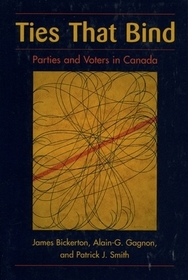
Ties that Bind
Parties and Voters in Canada
- Publisher's listprice GBP 26.99
-
12 185 Ft (11 605 Ft + 5% VAT)
The price is estimated because at the time of ordering we do not know what conversion rates will apply to HUF / product currency when the book arrives. In case HUF is weaker, the price increases slightly, in case HUF is stronger, the price goes lower slightly.
- Discount 10% (cc. 1 219 Ft off)
- Discounted price 10 967 Ft (10 445 Ft + 5% VAT)
Subcribe now and take benefit of a favourable price.
Subscribe
12 185 Ft

Availability
Only to order.
Why don't you give exact delivery time?
Delivery time is estimated on our previous experiences. We give estimations only, because we order from outside Hungary, and the delivery time mainly depends on how quickly the publisher supplies the book. Faster or slower deliveries both happen, but we do our best to supply as quickly as possible.
Product details:
- Publisher OUP Canada
- Date of Publication 16 September 1999
- ISBN 9780195412765
- Binding Paperback
- No. of pages260 pages
- Size 229x153x15 mm
- Weight 368 g
- Language English 0
Categories
Long description:
Viewed from afar, electoral politics in Canada may seem a strange amalgam of predictability and surprise, stability and volatility. At the close of the twentieth century, the party in power is the same one that governed at the beginning of the century and for an inordinate amount of time in between. Yet the contemporary party system seems to bear little relation to that which characterized either turn-of-the-century or mid-century Canadian politics. In fact, several dramatic upheavals have taken place in the relationship between parties and voters. Elections clarify for parties and voters the current character of their relations. Partially obscured, vaguely calibrated, or hidden perils in the voter-party relationship will often rise to the surface during election periods, and the ties that bind diverse communities of voters to particular parties are tested.
Clearly, the relationship between Canadian voters and their political parties has seldom been an easy one, especially at election time. However, to describe it as unstable or volatile would be misleading. There have always been strong currents of continuity and stability in voter-party relations in Canada that are deeply rooted in regional political cultures and party histories, in enduring ties between ethnocultural or linguistic groupings and particualr parties, and in the economic and class cleavages that influence left-right ideological divisions.
Ties That Bind looks at the socio-economic, ethnolinguistic, and demographic factors in party support; the enduring quality of these social bases; the importance of geography in structuring variations in the voter-party relationship; and electoral change as a function of the strategic decisions of the parties and their leaders and the voter response these decisions evoke.
This is an excellent, nontechnical history and analysis of Canada's political parties and their relationship with the electorate since the country's inception....Useful for undergraduate courses in Canadian politics, political parties, and even Canadian history.
Table of Contents:
Acknowledgements
Notes on the Authors
Parties and Voters in Canada
the Progressive Conservatives: Broken Ties, Broken Dreams
The Liberals: Canada's 'Government Party'
The New Democrats: What's Left in Party Politics in Canada
The Reform Party: Reaching for the Right
The Bloc Quebecois and its Nationalist Predecessors: The Thread of Continuity in Quebec History
Continuity and Change in a New Era of Party Politics
Apendices

