

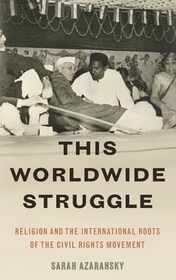
This Worldwide Struggle
Religion and the International Roots of the Civil Rights Movement
- Publisher's listprice GBP 41.49
-
18 732 Ft (17 840 Ft + 5% VAT)
The price is estimated because at the time of ordering we do not know what conversion rates will apply to HUF / product currency when the book arrives. In case HUF is weaker, the price increases slightly, in case HUF is stronger, the price goes lower slightly.
- Discount 10% (cc. 1 873 Ft off)
- Discounted price 16 859 Ft (16 056 Ft + 5% VAT)
Subcribe now and take benefit of a favourable price.
Subscribe
18 732 Ft

Availability
printed on demand
Why don't you give exact delivery time?
Delivery time is estimated on our previous experiences. We give estimations only, because we order from outside Hungary, and the delivery time mainly depends on how quickly the publisher supplies the book. Faster or slower deliveries both happen, but we do our best to supply as quickly as possible.
Product details:
- Publisher OUP USA
- Date of Publication 6 July 2017
- ISBN 9780190262204
- Binding Hardback
- No. of pages296 pages
- Size 239x152x30 mm
- Weight 540 g
- Language English 0
Categories
Short description:
This Worldwide Struggle: Religion and the International Roots of the Civil Rights Movement examines a group of black Christian intellectuals and activists who looked abroad, even to other religious traditions, for ideas and practices that could transform American democracy.
MoreLong description:
This Worldwide Struggle: Religion and the International Roots of the Civil Rights Movement examines a group of black Christian intellectuals and activists who looked abroad, even to other religious traditions, for ideas and practices that could transform American democracy. From the 1930s to the 1950s, this core group drew lessons from independence movements around for the world for an American campaign that would be part of a global network of resistance to colonialism and white supremacy. This book argues that their religious perspectives and methods of moral reasoning developed a theological blueprint for what Bayard Rustin called the "classical phase" of the Civil Rights Movement.
Existing scholarship on the book's main figures, including Howard Thurman, Benjamin Mays, and William Stuart Nelson, pioneers of African American Christian nonviolence James Farmer, Pauli Murray, and Bayard Rustin, and YWCA leaders Juliette Derricotte and Sue Bailey Thurman, focuses on individuals and misses important streams of influence and creative collaborations. This book traces fertile intersections of worldwide resistance movements, explores American racial politics and interreligious exchanges that crossed literal borders and disciplinary boundaries, enriches our understanding of the international roots of the Civil Rights Movement, and offers lessons on the role of religion in justice movements.
Azaransky's book is both an inspiration and a caution to those interested in the ongoing struggle for justice anywhere--economic, racial, gender or environmental. Her exploration of her subjects' early lives gives the reader a way to connect with their own sources of spiritual, religious and moral energy, stamina and courage. Her depiction of the huge network of connections and relationships across cities, countries and continents reminds activists and allies of the importance of the need for solidarity, humility and communication with allies.
Table of Contents:
Introduction Part of This Worldwide Struggle
Chapter 1 Spiritual Recognition of Empire (1930s)
Chapter 2 Passing Through a Similar Transition (1930s)
Chapter 3 We Can Add to the World Justice (1940s)
Chapter 4 An Admixture of Tragedy and Triumph (1940s)
Chapter 5 Opposing Injustice, First of All in Ourselves (1940s & 1950s)
Chapter 6 Moral Leadership of the World (1950s)

