

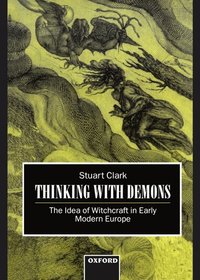
Thinking with Demons
The Idea of Witchcraft in Early Modern Europe
- Publisher's listprice GBP 120.00
-
54 180 Ft (51 600 Ft + 5% VAT)
The price is estimated because at the time of ordering we do not know what conversion rates will apply to HUF / product currency when the book arrives. In case HUF is weaker, the price increases slightly, in case HUF is stronger, the price goes lower slightly.
- Discount 10% (cc. 5 418 Ft off)
- Discounted price 48 762 Ft (46 440 Ft + 5% VAT)
Subcribe now and take benefit of a favourable price.
Subscribe
54 180 Ft

Availability
printed on demand
Why don't you give exact delivery time?
Delivery time is estimated on our previous experiences. We give estimations only, because we order from outside Hungary, and the delivery time mainly depends on how quickly the publisher supplies the book. Faster or slower deliveries both happen, but we do our best to supply as quickly as possible.
Product details:
- Publisher OUP Oxford
- Date of Publication 30 January 1997
- ISBN 9780198200017
- Binding Hardback
- No. of pages844 pages
- Size 243x162x48 mm
- Weight 1318 g
- Language English
- Illustrations 2 halftones 0
Categories
Short description:
This is a work of fundamental importance for our understanding of the intellectual and cultural history of early modern Europe. Stuart Clark offers a new interpretation of the witchcraft beliefs of European intellectuals between the fifteenth and eighteenth centuries, based on their publications in the field of demonology. He shows how these beliefs fitted rationally with other views current in Europe throughout that period, and underlines just how far the nature of rationality is dependent on its historical context.
MoreLong description:
This is a work of fundamental importance for our understanding of the intellectual and cultural history of early modern Europe. Stuart Clark offers a new interpretation of the witchcraft beliefs of European intellectuals based on their publications in the field of demonology, and shows how these beliefs fitted rationally with many other views current in Europe between the fifteenth and eighteenth centuries.
Professor Clark is the first to explore the appeal of demonology to early modern intellectuals by looking at the books they published on the subject during this period. After examining the linguistic foundations of their writings, the author shows how the writers' ideas about witchcraft (and about magic) complemented their other intellectual commitments--in particular, their conceptions of nature, history, religion, and politics. The result is much more than a history of demonology. It is a survey of wider intellectual and ideological purposes, and underlines just how far the nature of rationality is dependent on its historical context.
This massive and rich book is brimming with suggestions for future researchers. Clark's bibliography is itself a contribution to witchcraft scholarship. Thinking with Demons will become a classic.

