

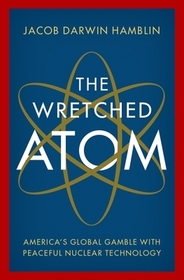
The Wretched Atom
America's Global Gamble with Peaceful Nuclear Technology
- Publisher's listprice GBP 28.99
-
13 088 Ft (12 465 Ft + 5% VAT)
The price is estimated because at the time of ordering we do not know what conversion rates will apply to HUF / product currency when the book arrives. In case HUF is weaker, the price increases slightly, in case HUF is stronger, the price goes lower slightly.
- Discount 20% (cc. 2 618 Ft off)
- Discounted price 10 471 Ft (9 972 Ft + 5% VAT)
- Discount is valid until: 30 June 2026
Subcribe now and take benefit of a favourable price.
Subscribe
13 088 Ft

Availability
Estimated delivery time: In stock at the publisher, but not at Prospero's office. Delivery time approx. 3-5 weeks.
Not in stock at Prospero.
Why don't you give exact delivery time?
Delivery time is estimated on our previous experiences. We give estimations only, because we order from outside Hungary, and the delivery time mainly depends on how quickly the publisher supplies the book. Faster or slower deliveries both happen, but we do our best to supply as quickly as possible.
Product details:
- Publisher OUP USA
- Date of Publication 9 December 2021
- ISBN 9780197526903
- Binding Hardback
- No. of pages328 pages
- Size 157x239x30 mm
- Weight 612 g
- Language English
- Illustrations 20 halftones 161
Categories
Short description:
Written by a prize-winning historian, The Wretched Atom is an authoritative history and a sweeping indictment of so-called peaceful nuclear technologies in the countries of the developing world.
MoreLong description:
A groundbreaking narrative of how the United States offered the promise of nuclear technology to the developing world and its gamble that other nations would use it for peaceful purposes.
After the Second World War, the United States offered a new kind of atom that differed from the bombs that destroyed Hiroshima and Nagasaki. This atom would cure diseases, produce new foods, make deserts bloom, and provide abundant energy for all. It was an atom destined for the formerly colonized, recently occupied, and mostly non-white parts of the world that were dubbed the "wretched of the earth" by Frantz Fanon.
The "peaceful atom" had so much propaganda potential that President Dwight Eisenhower used it to distract the world from his plan to test even bigger thermonuclear weapons. His scientists said the peaceful atom would quicken the pulse of nature, speeding nations along the path of economic development and helping them to escape the clutches of disease, famine, and energy shortfalls. That promise became one of the most misunderstood political weapons of the twentieth century. It was adopted by every subsequent US president to exert leverage over other nations' weapons programs, to corner world markets of uranium and thorium, and to secure petroleum supplies. Other countries embraced it, building reactors and training experts. Atomic promises were embedded in Japan's postwar recovery, Ghana's pan-Africanism, Israel's quest for survival, Pakistan's brinksmanship with India, and Iran's pursuit of nuclear independence.
As The Wretched Atom shows, promoting civilian atomic energy was an immense gamble, and it was never truly peaceful. American promises ended up exporting violence and peace in equal measure. While the United States promised peace and plenty, it planted the seeds of dependency and set in motion the creation of today's expanded nuclear club.
Throughout the work, Hamblin's thoughtful attention to the neocolonial workings of the "cornucopian illusion" of atomic power transforms what could have been a staid programmatic history into a much richer story at the intersection of the history of science and technology, diplomatic history, and the history of decolonization.
Table of Contents:
Acknowledgments
Introduction
Chapter One: The Have-Nots
Chapter Two: A Thousand Years into One
Chapter Three: Forgetting the Bad Dreams of the Past
Chapter Four: Colored and White Atoms
Chapter Five: Turf Wars and Green Revolutions
Chapter Six: Water, Blood, and the Nuclear Club
Chapter Seven: Nuclear Mosques and Monuments
Chapter Eight: The Era of Distrust
Conclusion: The Cornucopian Illusion
Notes
Index

