

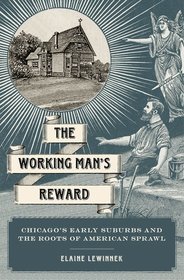
The Working Man's Reward
Chicago's Early Suburbs and the Roots of American Sprawl
- Publisher's listprice GBP 65.00
-
29 347 Ft (27 950 Ft + 5% VAT)
The price is estimated because at the time of ordering we do not know what conversion rates will apply to HUF / product currency when the book arrives. In case HUF is weaker, the price increases slightly, in case HUF is stronger, the price goes lower slightly.
- Discount 10% (cc. 2 935 Ft off)
- Discounted price 26 413 Ft (25 155 Ft + 5% VAT)
Subcribe now and take benefit of a favourable price.
Subscribe
29 347 Ft

Availability
printed on demand
Why don't you give exact delivery time?
Delivery time is estimated on our previous experiences. We give estimations only, because we order from outside Hungary, and the delivery time mainly depends on how quickly the publisher supplies the book. Faster or slower deliveries both happen, but we do our best to supply as quickly as possible.
Product details:
- Publisher OUP USA
- Date of Publication 5 June 2014
- ISBN 9780199769223
- Binding Hardback
- No. of pages250 pages
- Size 155x229x27 mm
- Weight 567 g
- Language English
- Illustrations 20 illus. 0
Categories
Short description:
Between the 1860s and 1920s, Chicago's working-class immigrants designed the American dream of home-ownership, viewing homes as a consumer-oriented respite from work and a productive space they hoped to control. Spurred by ideas about the gendered respectability of domesticity, early city planning and land economics, Chicagoans helped create America's suburbanization.
MoreLong description:
Between the 1860s and 1920s, Chicago's working-class immigrants designed the American dream of home-ownership. They imagined homes as small businesses, homes that were simultaneously a consumer-oriented respite from work and a productive space that workers hoped to control. Leapfrogging out of town along with Chicago's assembly-line factories, Chicago's early suburbs were remarkably diverse. These suburbs were marketed with the elusive promise that homeownership might offer some bulwark against the vicissitudes of industrial capitalism, that homes might be "better than a bank for a poor man," in the words of one evocative advertisement, and "the working man's reward." This promise evolved into what Lewinnek terms "the mortgages of whiteness:" the hope that property values might increase if that property could be kept white. Suburbs also developed through nineteenth-century notions of the gendered respectability of domesticity, early ideas about city planning and land economics, as well as an evolving twentieth-century discourse about the racial attributes of property values. Because Chicago presented itself as a paradigmatic American city and because numerous Chicago-based experts eventually instituted national real-estate programs, Chicago's early growth affected the growth of twentieth-century America. Framed by two working-class riots against suburbanization in 1872 and 1919, spurred from both above and below, this work shows how Chicagoans helped form America's urban sprawl and examines the roots of America's suburbanization, synthesizing the new suburban history into the diversity of America's suburbs.
In her outstanding new book ... Elaine Lewinnek explores the fascinating complexity of how Chicago's suburbs have been defined and how they have evolved ... Lewinnek has written one of the best books about Chicago in a long time, and reading it will reward any working or thinking man or woman interested in Chicago, or its suburbs, old or new.
Table of Contents:
Acknowledgments
Introduction: "Chicago is America's Dream, Writ Large": Forging the Suburban Dream in Early Chicago
1. "Vast and Sudden Municipality": Boosting and Lamenting Chicago's Growth
2. "Domestic and Respectable": Property-Owner Politics after the Great Chicago Fire
3. Lake and Jungle: The Assembly-line Factory as a Force for Suburbanization
4. "Better than a Bank for a Poor Man": Worker's Strategies for Home Financing
5. Mapping Chicago, Imagining Metropolises: Reconsidering the Zonal Model of Urban Growth
6. The Mortgages of Whiteness: Chicago's Race Riots of 1919
Conclusion: The City of the Twentieth Century
Notes
Bibliography
Index

