

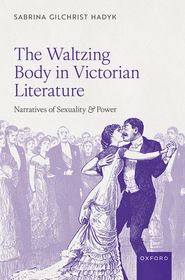
The Waltzing Body in Victorian Literature
Narratives of Sexuality and Power
- Publisher's listprice GBP 77.00
-
34 765 Ft (33 110 Ft + 5% VAT)
The price is estimated because at the time of ordering we do not know what conversion rates will apply to HUF / product currency when the book arrives. In case HUF is weaker, the price increases slightly, in case HUF is stronger, the price goes lower slightly.
- Discount 10% (cc. 3 476 Ft off)
- Discounted price 31 289 Ft (29 799 Ft + 5% VAT)
Subcribe now and take benefit of a favourable price.
Subscribe
34 765 Ft

Availability
Estimated delivery time: In stock at the publisher, but not at Prospero's office. Delivery time approx. 3-5 weeks.
Not in stock at Prospero.
Why don't you give exact delivery time?
Delivery time is estimated on our previous experiences. We give estimations only, because we order from outside Hungary, and the delivery time mainly depends on how quickly the publisher supplies the book. Faster or slower deliveries both happen, but we do our best to supply as quickly as possible.
Product details:
- Publisher OUP Oxford
- Date of Publication 8 May 2025
- ISBN 9780198932529
- Binding Hardback
- No. of pages240 pages
- Size 240x164x20 mm
- Weight 544 g
- Language English
- Illustrations 26 black and white images/figures 585
Categories
Short description:
The Waltzing Body in Victorian Literature traces the evolution of the waltz from subversive to traditional across the 19th century, focusing on the Victorian authors who wrote about the waltz, exploring ideas around sexual desire, female empowerment, shifting masculinity, queer erasure, and the fear of being left behind in a modernizing world.
MoreLong description:
The Waltzing Body in Victorian Literature: Narratives of Sexuality and Power traces the evolution of the waltz from a taboo dance in the early nineteenth century to a gracefully nostalgic practice that must be preserved by the century's end. While Sabrina Gilchrist Hadyk references eighteenth-century authors to frame the waltz's initial reception in England, the study focuses primarily on Victorian authors who shaped how and why this dance was paradoxically viewed as elegant, effeminate, and sterile. Hadyk explores female sexuality and the concept of choice in the ballroom; a shifting and sometimes contradictory understanding of masculinity through male performance; the erasure of and reclamation of queer desire in heterosexual courting spaces; and the rhetoric of new technologies that attempted to contain, shape, and memorialize a temporal art form. A brief epilogue considers how late-Victorian (and heavily sanitized and romanticized) depictions of the waltz reverberate today in popular films and reality TV, which perpetuate Victorian assumptions about class, gender, sexuality, and more. By understanding the history of the waltz, the reader is invited to examine the dizzying discomfort that many Victorians expressed about forging ahead into a modern (and modernizing) world, particularly at the turn of the century. With comparatively little scholarship around understanding dance scenes and dance semiotics in literature, this book articulates a new interpretive path for familiar and unfamiliar nineteenth-century narratives, offering new ways of understanding and engaging with the role and culture of dance.
This book articulates a new interpretive path for familiar and unfamiliar nineteenth-century narratives, offering new ways of understanding and engaging with the role and culture of dance.
Table of Contents:
Introduction: The Emergence and (Im)Permanence of the Waltz
Lady's Choice: Sexual Selection in the Waltzing Ballroom
Take the Lead: The Changing Role of Men in the Waltzing Ballroom
Lascivious Revolutions: Queering the Waltzing Ballroom
Keeping Perfect Time: Technology's Impact on the Dancing Body
Epilogue: Circling Back to the Waltz and Reliving (Pseudo-)Victorianism Today

