

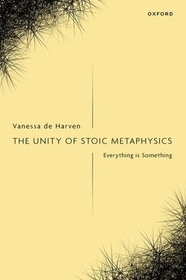
The Unity of Stoic Metaphysics
Everything is Something
- Publisher's listprice GBP 140.00
-
63 210 Ft (60 200 Ft + 5% VAT)
The price is estimated because at the time of ordering we do not know what conversion rates will apply to HUF / product currency when the book arrives. In case HUF is weaker, the price increases slightly, in case HUF is stronger, the price goes lower slightly.
- Discount 10% (cc. 6 321 Ft off)
- Discounted price 56 889 Ft (54 180 Ft + 5% VAT)
Subcribe now and take benefit of a favourable price.
Subscribe
63 210 Ft

Availability
printed on demand
Why don't you give exact delivery time?
Delivery time is estimated on our previous experiences. We give estimations only, because we order from outside Hungary, and the delivery time mainly depends on how quickly the publisher supplies the book. Faster or slower deliveries both happen, but we do our best to supply as quickly as possible.
Product details:
- Publisher OUP Oxford
- Date of Publication 26 December 2024
- ISBN 9780198930167
- Binding Hardback
- No. of pages560 pages
- Size 240x165x35 mm
- Weight 976 g
- Language English 549
Categories
Short description:
This volume explores the metaphysics devised by Stoic philosophers in response to Plato. It elucidates ontological criteria for counting things as being, and metaphysical principles for grounding these entities, which together support the view that everything there is either is a body or is something ontologically dependent on body.
MoreLong description:
The Unity of Stoic Metaphysics argues that the Stoics were sophisticated metaphysical thinkers responding to Plato's Sophist and forging a bold new path between materialism and idealism, with a one-world metaphysics best characterized as non-reductive physicalism. The book is divided into five sections:
Section I, Something, develops the suggestion that the Stoics arrived at the genus Something and their two ontological criteria for being Something by careful reflection on Plato's Sophist, finding new depth to Plato's challenges as well as to the Stoic response.
Section II, Bodies, offers an account of Stoic corporealism that takes us from the ontology of what exists to the metaphysics of body, explaining how body can be the fundamental grounds of the cosmos and how qualities can be corporeal.
Section III, Incorporeals, takes us beyond corporealism to physicalism. It argues that the Stoic incorporeals--space, time, and the lekta, or sayables--are all dependent on body for their subsistence, inheriting their spatial, temporal, and semantic properties from underlying body without being nothing but the body.
Section IV, Neither Corporeal nor Incorporeal, argues in support of a tripartite ontology that includes a third class of entities that are neither corporeal nor incorporeal--limits of the continuum, geometrical limits, and creatures of fiction.
Section V, Everything, returns to the Stoic ontology, arguing that concepts are not Something, thus no reason remains to posit a further class of entities, Not-Somethings (outina), in metaphysical limbo between Something and nothing at all. The genus Something is complete and comprehensive as it stands. Everything is Something.
The Unity of Stoic Metaphysics is a significant contribution to the literature on Stoicism and the history of metaphysics. It gives a thorough and impressively cohesive account of Stoic metaphysics and ontology; it is philosophically astute and rich with original and distinctive interpretations well worth consideration.
Table of Contents:
Introduction
Section I. Something
Plato's Sophist
Ontological Criteria
Section II. Bodies
Body as Such
Bodies Blending
Basic Bodies
Building Bodies
The Categories, State of the Debate
The Categories, A Fresh Start
Section III. Incorporeals
The Incorporeals, A Grounded Account
Space
Time
The Lekta, Why Language is Earthborn Too
Section IV. Neither Corporeal nor Incorporeal, or: What Subsists according to Thought
Limits
Creatures of Fiction
Section V. Everything
Concepts
Everything is Something

