

- Publisher's listprice GBP 93.00
-
44 430 Ft (42 315 Ft + 5% VAT)
The price is estimated because at the time of ordering we do not know what conversion rates will apply to HUF / product currency when the book arrives. In case HUF is weaker, the price increases slightly, in case HUF is stronger, the price goes lower slightly.
- Discount 10% (cc. 4 443 Ft off)
- Discounted price 39 988 Ft (38 084 Ft + 5% VAT)
Subcribe now and take benefit of a favourable price.
Subscribe
44 430 Ft

Availability
Estimated delivery time: In stock at the publisher, but not at Prospero's office. Delivery time approx. 3-5 weeks.
Not in stock at Prospero.
Why don't you give exact delivery time?
Delivery time is estimated on our previous experiences. We give estimations only, because we order from outside Hungary, and the delivery time mainly depends on how quickly the publisher supplies the book. Faster or slower deliveries both happen, but we do our best to supply as quickly as possible.
Product details:
- Publisher OUP Oxford
- Date of Publication 23 March 2021
- ISBN 9780198869566
- Binding Hardback
- No. of pages318 pages
- Size 240x164x22 mm
- Weight 642 g
- Language English 98
Categories
Short description:
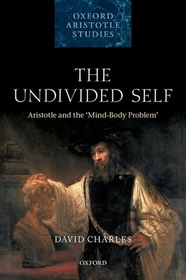
Aristotle initiated the systematic investigation of perception, the emotions, memory, desire, and action. David Charles argues that Aristotle's account of these phenomena is a philosophically live alternative to conventional modern thinking about the mind: it offers a way to dissolve, rather than solve, the mind-body problem we have inherited.
MoreLong description:
Aristotle initiated the systematic investigation of perception, the emotions, memory, desire and action, developing his own account of these phenomena and their interconnection. The aim of this book is to gain a philosophical understanding of his views and to examine how far they withstand critical scrutiny. Aristotle's account, it is argued, constitutes a philosophically live alternative to conventional post-Cartesian thinking about psychological phenomena and their place in a material world. It offers a way to dissolve, rather than solve, the mind-body problem we have inherited.
This exegetical work...makes an important contribution to our philosophical understanding of the mind body relationship.
Table of Contents:
Introduction
The Emotions
Enmattered form: Aristotle's Hylomorphism
Desire and Action
Taste and Smell: with some remarks on Touch
Hearing, Seeing and Hylomorphism
Perception, Desire and Action: inextricably embodied subjects
Aristotle's Viewpoint
Aristotle's Undivided Self

