

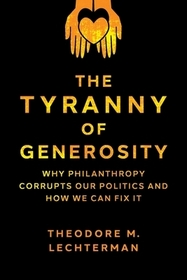
The Tyranny of Generosity
Why Philanthropy Corrupts Our Politics and How We Can Fix It
- Publisher's listprice GBP 29.99
-
13 540 Ft (12 895 Ft + 5% VAT)
The price is estimated because at the time of ordering we do not know what conversion rates will apply to HUF / product currency when the book arrives. In case HUF is weaker, the price increases slightly, in case HUF is stronger, the price goes lower slightly.
- Discount 10% (cc. 1 354 Ft off)
- Discounted price 12 186 Ft (11 606 Ft + 5% VAT)
Subcribe now and take benefit of a favourable price.
Subscribe
13 540 Ft

Availability
Estimated delivery time: In stock at the publisher, but not at Prospero's office. Delivery time approx. 3-5 weeks.
Not in stock at Prospero.
Why don't you give exact delivery time?
Delivery time is estimated on our previous experiences. We give estimations only, because we order from outside Hungary, and the delivery time mainly depends on how quickly the publisher supplies the book. Faster or slower deliveries both happen, but we do our best to supply as quickly as possible.
Product details:
- Publisher OUP USA
- Date of Publication 5 January 2022
- ISBN 9780197611418
- Binding Hardback
- No. of pages280 pages
- Size 150x216x23 mm
- Weight 440 g
- Language English 152
Categories
Short description:
The Tyranny of Generosity investigates what democracy demands from philanthropic giving and the policies that structure it. Drawing on political philosophy but addressed to a wide audience, it sheds new light on how philanthropy can both frustrate and facilitate democratic ideals. The author evaluates the respective roles of philanthropy and government, public subsidies for private giving, the use of donations for political speech, instruments of perpetual giving, the rise in giving by commercial corporations, and "effective altruism" as a guide for individual giving. Written accessibly, it is a book for anyone who's ever had mixed feelings about clicking the "donate" button or thanking a benefactor.
MoreLong description:
The practice of philanthropy, which releases private property for public purposes, represents in many ways the best angels of our nature. But this practice's noteworthy virtues often obscure the fact that philanthropy also represents the exercise of private power.
In The Tyranny of Generosity, Theodore Lechterman shows how this private power can threaten the foundations of a democratic society. The deployment of private wealth for public ends may rival the authority of communities to determine their own affairs. And, in societies characterized by wide disparities in wealth, philanthropy often combines with background inequalities to make public decisions overwhelmingly sensitive to the preferences of the rich. Allowing private wealth to dictate social outcomes collides with core commitments of a democratic society, a society in which people are supposed to determine their common affairs together, on equal terms.
But why exactly is democracy valuable? How should these values be weighed against the liberty of donors and the many social benefits that philanthropy promises? Lechterman explores these questions by examining various topics in the practice of philanthropy: the respective roles of philanthropy and government, public subsidies for private giving, the use of donations for political speech, instruments of perpetual giving, the rise in giving by commercial corporations, and "effective altruism" as a guide for individual giving. These studies build to a surprising conclusion: realizing the democratic ideal may be impossible without philanthropy--but making philanthropy safe for democracy also requires fundamental changes to policy and practice.
In this clear and fair-minded book, Lechterman argues that we shouldn't only evaluate philanthropy based on how effectively it alleviates poverty or how faithfully it accords with liberal principles of justice. We should also examine it from a democratic perspective, and think about how it shapes power relations. Supporters and critics of philanthropy alike will learn a lot from Lechterman's careful and penetrating analysis.
Table of Contents:
Chapter 1. Looking the Gift Horse in the Mouth
Chapter 2. Of Sovereignty and Saints
Chapter 3. A Farewell to Alms
Chapter 4. Donation and Deliberation
Chapter 5. In Usufruct to the Living
Chapter 6. The Effective Altruist's Political Problem
Chapter 7. Milton Friedman's Corporate Misanthropy
Chapter 8. Conclusion: Overthrowing the Tyranny of Generosity

